If the ball hits you or anything you are wearing or carrying, it is a fault against you wherever you are standing, even outside the court (Rule 10.C.3 of the 2026 USA Pickleball rulebook). The one exception is a ball that hits your hand below the wrist while that hand is holding the paddle.
In this article
Imagine you are rallying, the opponent returns your shot and it lightly clips your arm or shirt. Is that called a fault? What if you were standing outside the court?
In short, if the ball hits you, or touches anything that you are carrying before it bounces, it’s your fault and you will lose the rally.
Even seasoned players get confused when they are called to fault for it.
However there is a small exception, and some special cases that make this rule tricky.
Let’s dive deep into this rule.
The Official Rule (In Simple Terms)
Rule 10.C.3 of the 2026 USA Pickleball Official Rulebook says:
“After the serve, when the ball contacts a player or anything that is worn or carried by the player, except the player’s paddle or the player’s hands below the wrist joint while in contact with the paddle, it is a fault against that player.”
In simple terms, if a ball in play hits you or anything you wear or carry, it’s a fault, unless the contact is with your paddle hand below the wrist while holding the paddle.
It’s straightforward.
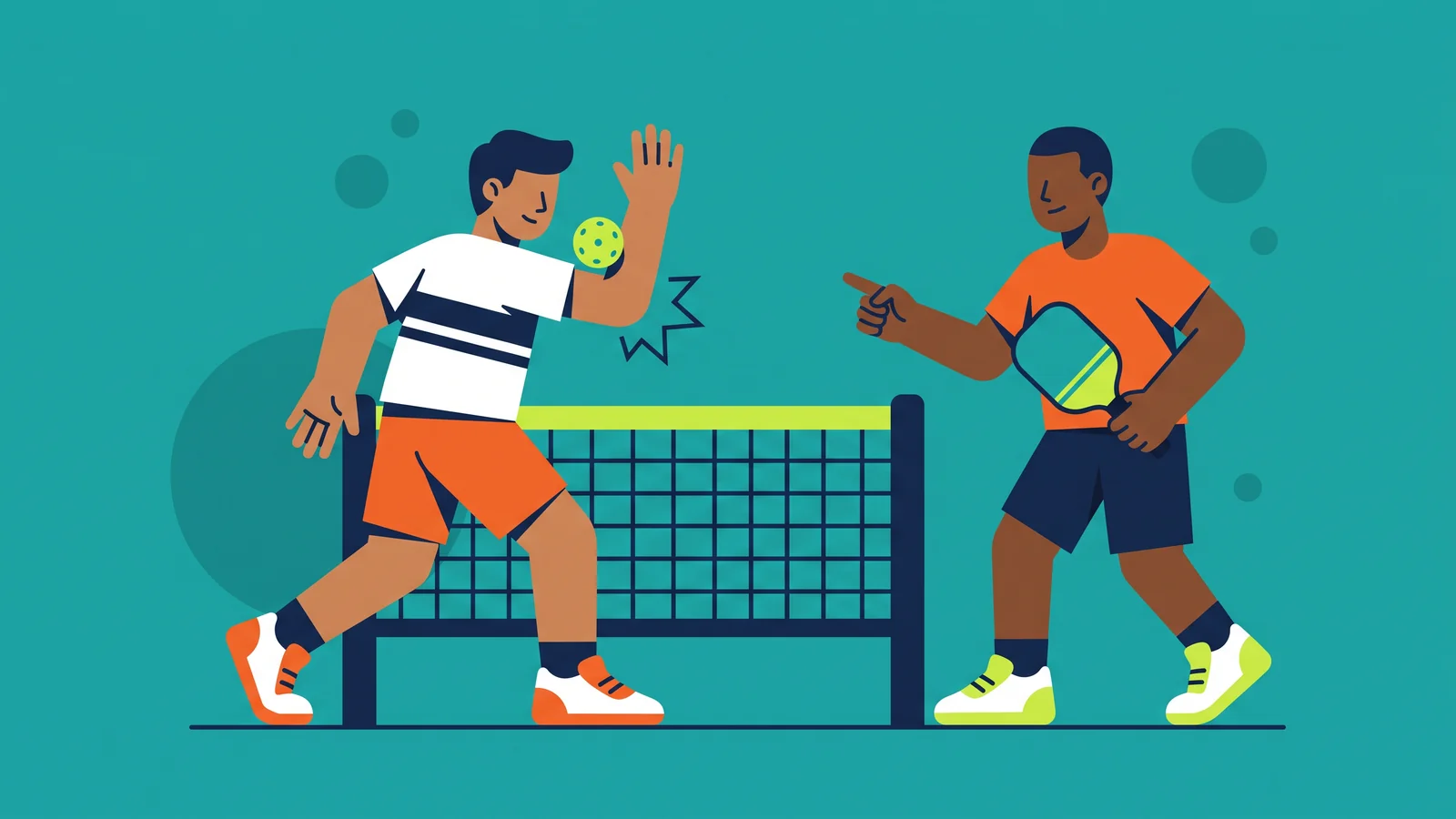
But what happens when you are standing out of the court?
This rule applies everywhere. Location doesn’t matter. You can be within the box, behind the baseline or out of the sidelines. If the ball touches you or even a strand of your hair, it will be your fault.
However, there is an exception to this rule. If the incoming ball hits your paddle hand, below the wrist while the paddle is in your hand, it won’t be counted as fault, the play will continue.
The rule says hands, so this works for a two-handed backhand as well. If both hands are on the paddle, a ball that hits either one below the wrist is not a fault. A hand only counts while it is touching the paddle, so if one hand has let go, a ball that hits it is a fault.
What is the meaning of the below wrist and above wrist?
The ball touches the knuckles or palm of the hand gripping the paddle and then deflects off that hand and goes over the net, it will be a legal move.
Above the wrist is the forearm, elbow and arm. If the ball touches any of these parts, it will be called a fault.
Here is the tricky part to this rule
If the ball touches your paddle hand when you are not holding the paddle for example after switching hands, it’s a fault. This can happen during exchange of fast kitchen volleys.
Let’s look into some common scenarios during Pickleball game
1. The Ball Hits You Before It Bounces
This is the most common situation during a Pickleball match. If the ball hits you in the air, before touching the ground, you lose the rally. Even if the ball’s trajectory was outward or it was a serve shot or you are standing out of bounds, the ball hasn’t touched the ground so it’s a fault.
2. The Ball Bounces First, Then Hits You
Now it gets confusing. If the ball bounces inside the court and hits you, you still lose the point unless you hit back.
3. You’re Standing Out of Bounds and the Ball Hits You
“If I’m out of bounds and the ball hits me before it lands, do I lose the point?”
Yes, you do. Because when the ball is still in the air and even if it is coming towards you who is standing out of bounds, it is still in play. If it touches you, that’s called a fault.
So don’t try to mess with the ball in air if it is going to land out of bounds.
4. Serve Hits You
Same applies while you’re receiving a serve shot, if the ball hits you before it bounces, you lose the rally (Rule 7.E.5). Make sure you let the serve bounce first. This is part of the two bounce rule in pickleball.
5. You Catch or Stop the Ball
Catching the ball is obviously a fault. You can let it land outside first and then grab it.
6. The Ball Hits Your Partner (in Doubles)
If the ball hits your partner during a doubles game, your team will lose the point. The moment that ball touches either of you (besides the paddle hand), that’s a fault. Having good communication during crucial games always helps you. A separate question is what happens when the ball touches your paddle twice, which is covered in double hit in pickleball.
How To Use This Rule in Your Game Strategically
Let’s look at both offensive and defensive takeaways.
Tip 1: Aim at the Body
It’s legal to hit the ball toward your opponent’s body. If your opponent is clumsy the ball will hit them and you will score an easy point.
You can aim towards their chest or shoulder during the volley. It’s hard to return the shot during a fast volley.
Tip 2: Stay Alert and Move
If your opponent has read above tip and tries the same on you, here’s how you should tackle it:
- You can pivot sideways to return it
- Duck if you are sure about its trajectory in order to avoid hitting bad shot
- Don’t shrink your shoulders in order to return the ball, you are definitely going to hit a bad one
Bonus tip:
Keep your clothing simple. Avoid wearing loose shirts, jewellery or open jackets that can fly during game and touch the ball causing loss of point.
Why This Rule Exists
Think of it another way, if the players could intentionally block shots with their bodies or clothes, everybody will try to touch the ball that they feel they cannot hit.
It ensures that the ball must always be played with the paddle. So the game stays fair and consistent with the right intent of hitting the ball with paddle.
Common Questions About the Ball Hitting You
Is it a fault if the ball was going out and hits me?
Yes. The ball is still in play until it lands. If it touches you or your clothes on its way out, you lose the rally, even though it would have been out a moment later.
Can I catch a ball that is clearly going out?
No. Catching it with your free hand or your body before it bounces counts as the ball hitting you, so it is a fault. Catching it on your paddle is a separate fault under Rule 12.C. Let it land first and then pick it up.
Is it legal to hit the ball at my opponent?
Yes. Rule 10.C counts a return that touches your opponent, or anything they wear or carry, before it lands as a good return. If it hits their body or clothing, the rally ends in your favour. If it hits their paddle, or their paddle hand below the wrist, it is not a fault and play goes on.
What if my hat falls on the court and the ball hits it?
If something you are wearing or carrying falls on your own side of the court, the rally goes on. Even if the ball then hits that item, it is not a fault against you (Rule 10.J). The exception is an item that lands in the kitchen while you volley, which is a non-volley zone fault under Rule 11.A.1.
Final Takeaway
Just keep in mind that ‘Ball must not touch any part of you except the hand below the wrist holding the paddle, everything will be called out as fault.’
I hope you understood this unique rule in Pickleball in depth. I tried to keep it simple and precise. In case you still have any doubt regarding this rule, you can comment below and I’ll be happy to help you through it.