Quick answer: A pop-up is a return that sits high enough for the opponent to hit down on. The usual causes are:
- your paddle face pointing too far upward,
- a wrist flick as the ball meets the paddle, or
- a swing that adds pace to a ball that is already fast.
In this article
Most fixes come down to the paddle face, where you meet the ball, and how long the swing is. The return still has to clear the net. If it sits up after that, the opponent can attack it again.
A reset takes pace off an attacking ball and sends back a lower, slower shot, ideally into the kitchen, so the other team has nothing easy to attack and the rally is neutral again.
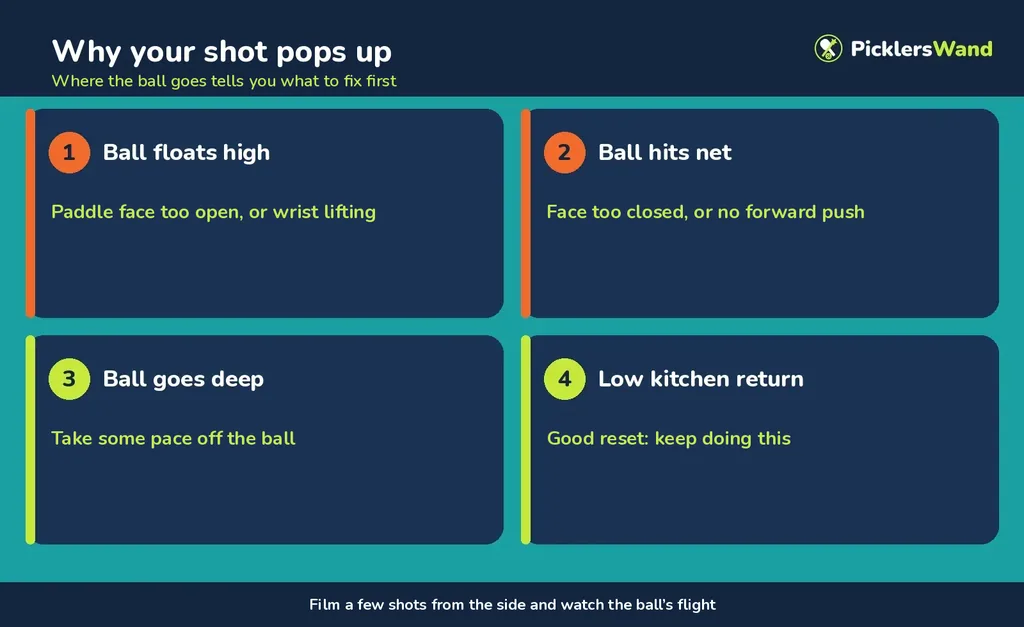
First, identify which ball is popping up
| Situation | Issue | How to fix |
|---|---|---|
| Blocking a hard, attacking ball | Paddle face tilted up, or too much swing | Keep the face neutral and the swing short |
| A soft dink keeps floating high | You are standing well behind the kitchen line | Move up to the kitchen line first, then make contact in front |
| Your reset keeps going into the net | The paddle face is usually closed | Open the face slightly and add a small forward guide |
| Your return lands deep, past the opponent’s kitchen | Too much power on the shot | Shorten the swing and use the pace already on the ball |
Film a few intentional shots from the side. The ball’s flight tells you more than a memory of how tight the grip felt.
What to change
1. Adjust the paddle face
Even a gentle block can pop up if the paddle face is tilted back. Keep the face less open. The exact angle still depends on the ball’s height, speed and where you meet it, so there is no one setting that works for every shot.
2. Make contact in front, without a wrist scoop
When the ball gets beside or behind you, it is tempting to flip the wrist up to save it. Get the paddle ready early, move your feet when there is time, and keep the stroke short. The coaching cue is guide, don’t lift. That does not mean freezing the paddle. A very slow ball may need a small, controlled push forward.
3. Use soft hands without a floppy paddle
On a fast ball, loosen the extra tension in your hand so the paddle can absorb pace. Keep it steady enough that the face does not flop open or closed. Grip-pressure numbers such as “3 out of 10” are coaching cues. No rulebook sets them, and they feel different from one player to the next. If the ball drops into the net, a softer grip alone may make the problem worse, so look at the face angle and the forward movement of the paddle as well as the grip.
How to hit a reset when you’re under attack
Imagine you’re in the transition zone and an opponent drives the ball toward your backhand. Rather than taking a full swing, set your paddle, bend to the ball’s height, and redirect the incoming pace in a soft arc into the opponent’s non-volley zone (the kitchen). Aim for a ball they must hit upward or dink, not one they can strike down.
The reset’s job is to buy a neutral next ball. It does not have to win the point. If you are still off balance after contact, get set before you move forward. A low reset may give you time to move up. A high one means you should get ready for another attack.
Professional player Catherine Parenteau, in a Selkirk coaching lesson, describes the reset as a soft defensive return that can restore a neutral exchange. Her advice includes targeting the kitchen and using a controlled arc when scrambling. This is coaching guidance, not a USA Pickleball rule.
Drills to find and fix the problem
Drill 1: Have a partner at the opposite kitchen line feed you medium-paced balls. Block them, changing only the paddle face angle. Film at least 10 shots, then count how many clear the net and stay low enough that your partner cannot attack them.
Drill 2: Stand a few steps behind the kitchen line while your partner hits controlled drives at you. Set the paddle face as you normally would and aim each return at their kitchen. If the ball pops up, check the wrist and paddle face. If it goes into the net, check the paddle face and the forward swing.
Drill 3: Start with a dink rally and let either player speed it up. Decide on each ball whether to reset or attack. Not every fast ball needs a reset or a soft return.
In every drill, only count a return if it would be hard to attack. Clearing the net is not enough.
FAQs
Should a reset always land in the kitchen?
The opponent’s kitchen is a good target, because a low, soft bounce there is harder to attack. The rulebook does not require it.
Is a reset the same as a dink or third-shot drop?
No. A dink is a soft shot traded near the kitchen line. A third-shot drop shot is usually played right after the return of serve. A reset is what you hit to regain control when the other team speeds the ball up.
How should I hold my paddle at exactly 3/10 pressure?
There is no exact way to measure it. “3 out of 10” is only a coaching cue. A simpler check is whether the paddle face stays where you set it as the ball arrives. If it twists, hold a little firmer.
Can I volley a reset while standing in the kitchen?
No. A volley is a fault if you are touching the non-volley zone when you hit it, or if your momentum carries you into the zone afterwards. You also need both feet back outside the zone before you volley. Once the ball has bounced, you can hit a reset from inside the kitchen.
These rules are in the USA Pickleball 2026 official rulebook, Section 11.A and 11.A.1 to 11.A.3. Section 9 of that edition covers dead balls, faults and hinders, not the kitchen.
Why do my resets hit the net after I soften my hands?
That often means the paddle did not move forward enough, or the face was too closed for that ball. Open the face slightly and keep a short forward guide.