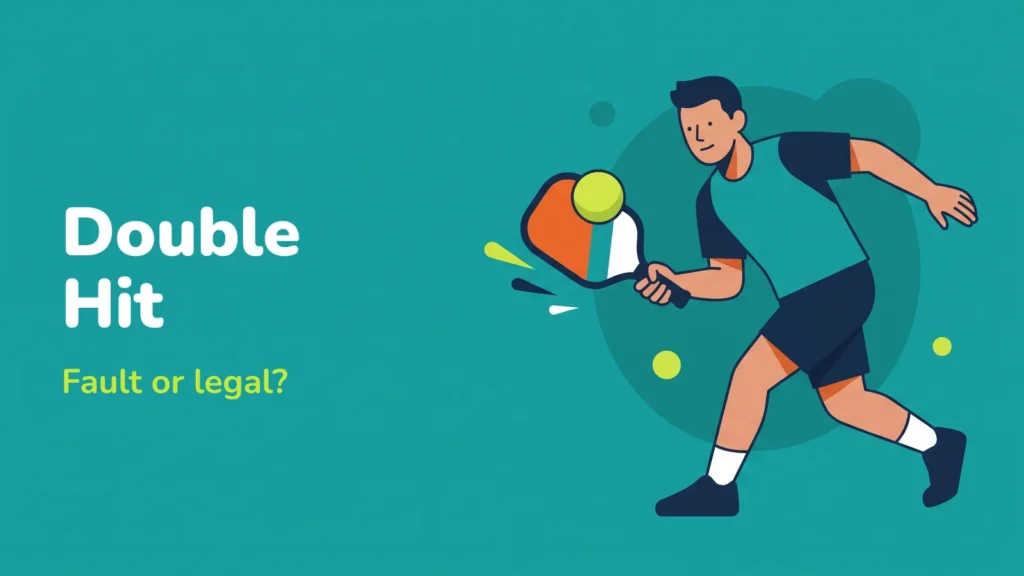
Quick answer: A double hit is legal only when it happens during one continuous stroke in a single direction by one player. If the stroke stops and restarts or changes direction, or if both you and your partner hit the ball, it is a fault (USA Pickleball 2026 Rule 10.D).
In this article
Ahh… the double hit! It sounds illegal even to pronounce this word. But you might be in for a surprise. Whether a double hit is legal or not in pickleball depends on how the stroke is made, not on the fact that the ball touched the paddle twice.
What is a double hit?
When the ball contacts the paddle more than once before it is returned, it is a double hit. The 2026 USA Pickleball Official Rulebook defines it in Section 2 as “Hitting the ball twice before it is returned.”
That definition only tells you what the term means. Whether it is a fault is decided by Rule 10.D.
The official rule (2026 USA Pickleball Rulebook)
“10.D Double Hit. Balls can be hit more than once, but the stroke must be continuous in a single direction by one player.
Source: USA Pickleball Official Rulebook (2026)
10.D.1 Fault – Double Hit. When a player hits a ball more than once using a stroke that is not continuous and in a single direction, it is a fault against that player.
10.D.2 Fault – Ball Hit by Two-Players. It is a fault if both a player and their partner strike the ball while attempting to return it.”
Note: in the 2025 rulebook this was Rule 11.A. From 2026 it is Rule 10.D, and it now says “more than once”, so a rare triple contact inside one stroke is judged the same way.
The two conditions that decide it
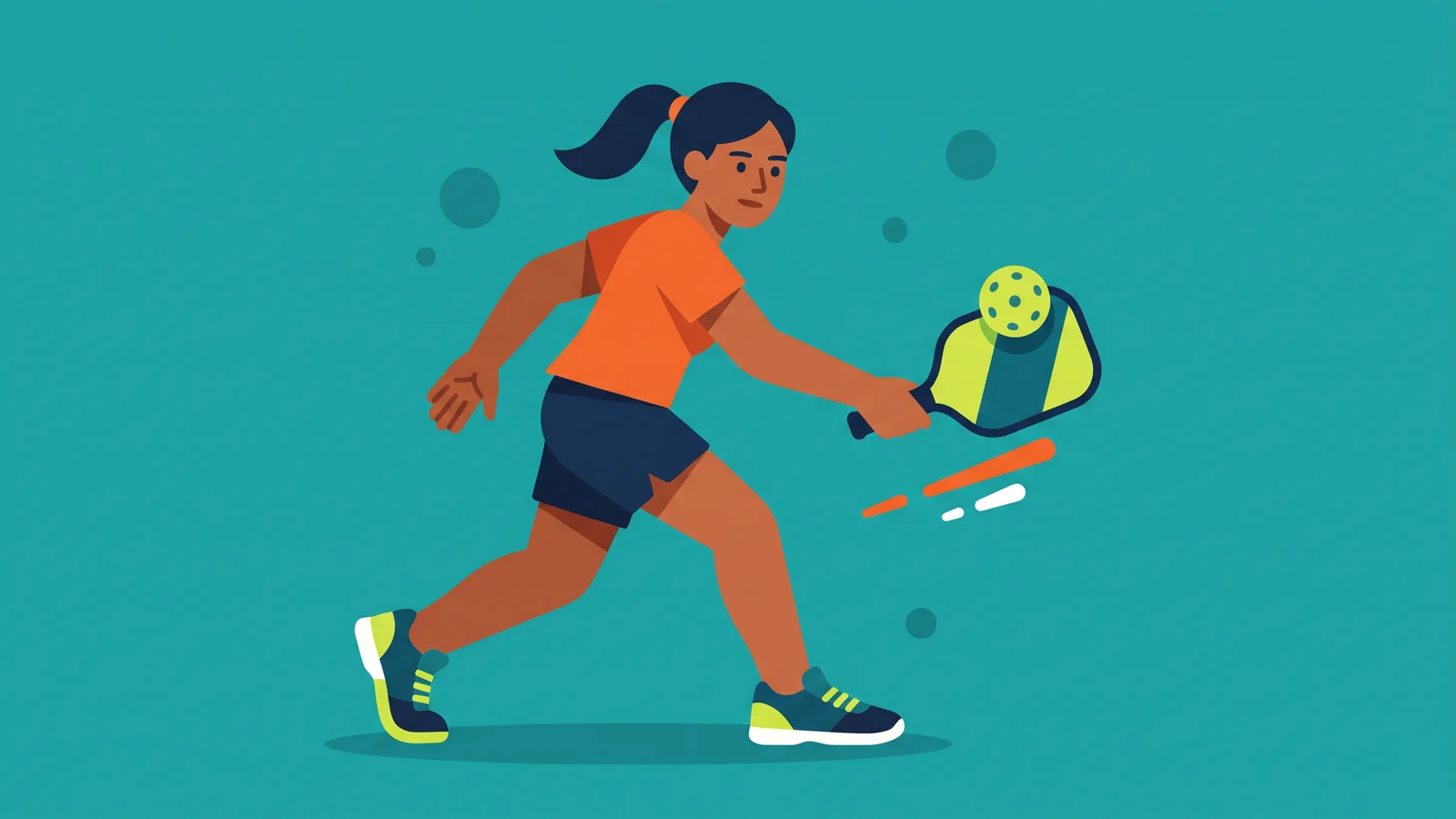
Rule 10.D gives the referee, or the players in a rec game, two things to check. The first is whether the stroke was continuous. The second is whether it moved in a single direction. Both have to be true. A third condition sits beside them: only one player on the team can be involved.
A continuous stroke is one swing with no stop in the middle. If the paddle pauses after the first contact and then pushes the ball again, that is two strokes, even if the gap is tiny.
A single direction means the paddle keeps travelling the same way through both contacts. If you pull the paddle back, or redirect it sideways to touch the ball a second time, the direction has changed and the shot is a fault under 10.D.1.
Notice what the rule does not say. It does not ask whether the second touch was intended, and it does not ask whether the player gained an advantage. Older explanations of the rule, including an earlier version of this post, talked about intent. The 2026 text only looks at the stroke itself, which is easier to judge from the outside.
When is a double hit legal?
A double hit is legal when the ball touches the paddle twice during one smooth swing that keeps going the same way. This usually happens in one of three situations.
The ball can hit the paddle and then glance off the edge guard or the face again as the swing continues. It can also happen on a hard drive or a block when the ball hits near the edge, skids and touches the face a second time. A third case is a mishit near the throat of the paddle, where the ball pops up off the face and meets the paddle again as you finish the same stroke.
In each case the player did not stop and swing again, so the contacts are part of one stroke.
When is a double hit a fault?
It is a fault under 10.D.1 when the player makes a second stroke at the ball. The common case is a ball that goes straight up after a weak first touch, and the player then taps it again to send it over. Another is a player who stops the ball on the paddle face and then pushes it forward, which also brings in the carry rule explained below.
It is a fault under 10.D.2 when both partners touch the ball on the same return. This happens most often on balls down the middle, when both players swing and both paddles make contact. Even if the second touch is the one that sends the ball over, the team has faulted. If you want to avoid that collision in the first place, the post on poaching etiquette in pickleball covers how partners usually split middle balls.
Real situations, step by step
Scenario 1: Illegal double hit. The ball comes towards you low and you just manage to reach it. The first touch has no power and the ball rises a little in front of you. You hit it again to get it over the net. These are two separate strokes, so it is a fault against you.
Scenario 2: Legal double hit. A player swings the paddle in a curved motion, the ball touches at one point on the face and again at another point during the same motion. The swing never stopped or reversed, so it is one continuous stroke in a single direction and the shot is legal.
Scenario 3: Partner contact. In doubles, a ball comes down the middle. You touch it first, it deflects, and your partner then hits it over. This is a fault under 10.D.2. It does not matter that your partner’s touch was the cleaner one.
Is a double hit the same as a carry?
No. They are covered by different rules.
The rulebook defines a carry as “Hitting the ball in such a way that it does not bounce away from the paddle but is carried along on the face of the paddle.” Rule 12.C says a player must not catch or carry the ball on the paddle during a rally, and 12.C.1 makes it a fault against that player.
The difference is that a double hit can be legal if it meets the conditions in 10.D, while the carry rule has no legal version. If the ball stays on the paddle face and is guided along with it, it is a fault whether it was intended or not.
Who calls a double hit?
In a refereed match the referee makes the call, because it is about the stroke and not about where the ball lands. In rec games there is usually no referee, so it falls to the players. Many players call their own double hits and carries, since the opponent is often too far away to see two contacts on a fast ball. Calling it on yourself is the honest thing to do and keeps rec games friendly.
If you are unsure what you saw on the other side, the rulebook definitions above are a fair way to talk it through: was the swing continuous, and did it keep going in one direction?
Conclusion
The double hit rule is not about how many times the ball touches your paddle. It is about whether you made one continuous, single direction stroke, and whether only one player on your team touched the ball. If you remember those two questions, most double hit arguments answer themselves.
Have you ever called a double hit on yourself or on your opponent? Share it in the comments below.
Related rules: What happens when the ball hits the net · What happens if the ball hits you · The two-bounce rule explained
Sources: USA Pickleball Official Rulebook 2026, Section 2 definitions (Carry, Double Hit), Rules 10.D, 10.D.1, 10.D.2, 12.C, 12.C.1 (https://usapickleball.org/docs/rules/USAP-Official-Rulebook.pdf).