Quick answer: DUPR (Dynamic Universal Pickleball Rating) is a free rating that puts every pickleball player on a scale from 2.000 to 8.000, worked out from real match scores. In DUPR’s own bands, 2.000 to 2.999 is Novice, 3.000 to 3.999 is Intermediate, 4.000 to 4.999 is Advanced and 5.000 to 8.000 is Professional. New players show as NR (Not Rated) until their first results come in. After that, the number moves after every match, depending on whether you scored more or fewer points than the ratings predicted.
In this article
Hey picklers! Did you know that the number of pickleball players in the US alone grew almost four times between 2019 and 2023?
Here are the quick stats.
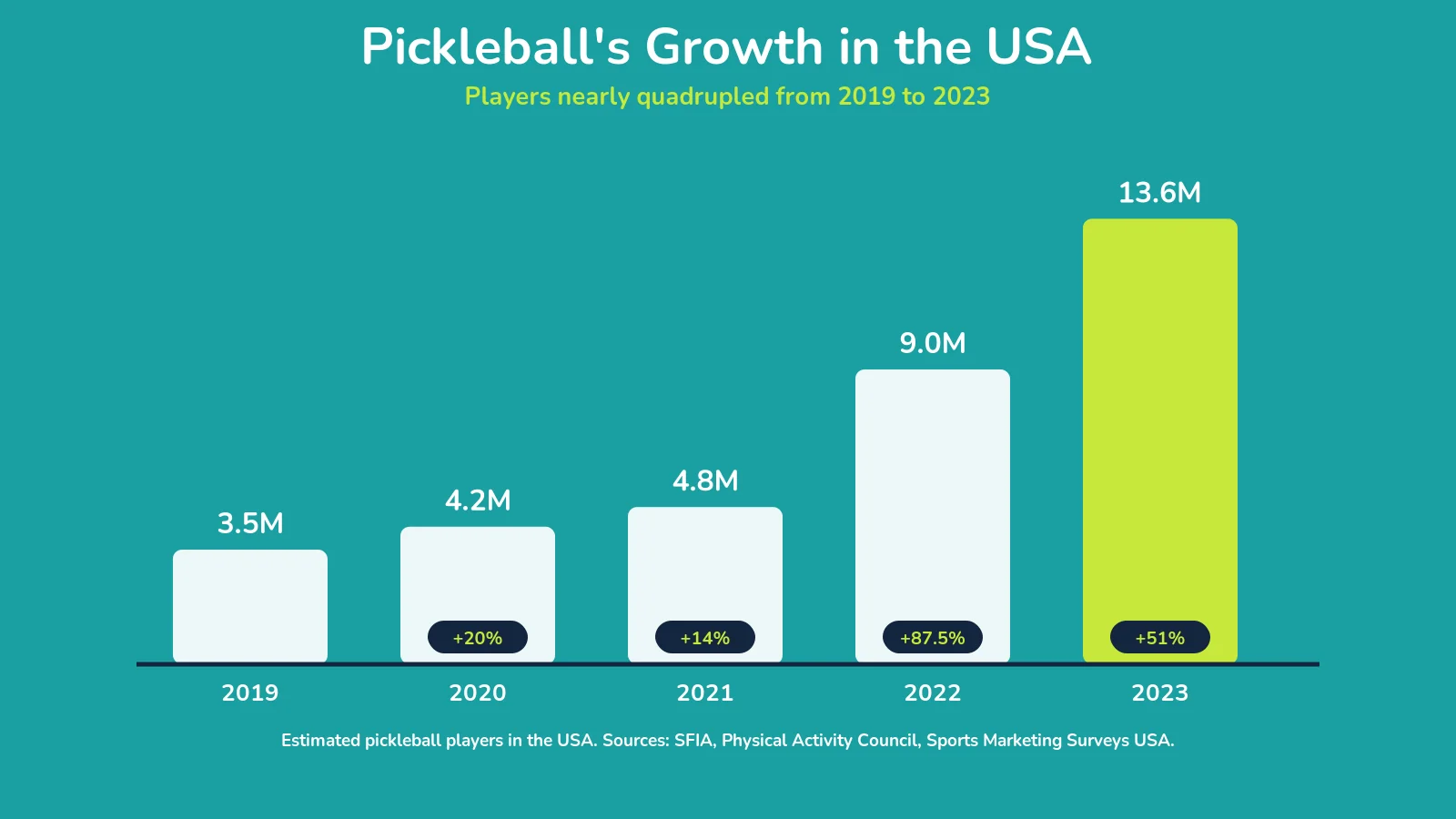
You can see how the popularity of pickleball has skyrocketed in just a few years.
If you haven’t paid attention in maths class, let me simplify the above image. It says that the USA went from about 3.5 million pickleball players in 2019 to 13.6 million at the end of 2023.
And the chart is already out of date. The newest count from the Sports & Fitness Industry Association (SFIA) is 24.3 million Americans who played pickleball in 2025. About 7.5 million of them played eight or more times that year, the group SFIA calls core players.
SFIA has named pickleball the fastest growing sport in America five years in a row.
Just like other professional sports ratings such as UTR in Tennis, USATT in Table tennis, there was a need for rating players in Pickleball too.
That’s when DUPR was created.
What is a DUPR rating?
DUPR was created in 2021 by Steve Kuhn, who also founded Major League Pickleball (MLP). Today the letters stand for Dynamic Universal Pickleball Rating, although Kuhn’s 2022 open letter on the DUPR blog calls it the Dreamland Universal Pickleball Rating, the same name as the Dreamland venue he opened.
DUPR is a community of picklers, where they can register for free and start logging their matches by sharing results. The core rating stays free. DUPR+ is an optional membership at $19.99 a year that adds extra stats, local rankings and a verified player badge, and DUPR says you don’t need it to have a rating.
The algorithm places players on a scale of 2.000 to 8.000. DUPR’s own guide splits that scale into four bands:
- Novice: 2.000 to 2.999
- Intermediate: 3.000 to 3.999
- Advanced: 4.000 to 4.999
- Professional: 5.000 to 8.000
You don’t get just one number either. DUPR keeps separate ratings for singles, doubles and mixed doubles, plus an age rating for players in the 50 to 65+ brackets. If you mostly play one on one, our guide on how to play pickleball singles covers the scoring and positioning.
What is a good DUPR rating?
There isn’t one good number. It depends on what you want from the game. Going by DUPR’s bands, anything from 3.000 up puts you in the Intermediate group, and 4.000 is where the Advanced label starts. If your first rating lands in the 2s, that only means you are in the Novice band, which is where the scale begins for everyone. A rating is most useful for finding games and events at your level, not as a score to compare with friends.
How DUPR calculates your rating
DUPR’s help centre describes the formula as a modified Elo system, the same family of rating used in chess. It looks at four things:
- Performance against expectation. Every match has an expected score based on the ratings of everyone on court. Score more points than expected and your rating goes up. Score fewer and it goes down, even if you won.
- Type of match. Self-posted matches count less than club, league or tournament results, and a best of three match counts more than a single game.
- How many matches you have. With lots of recent matches, your rating is treated as more reliable and moves less with each new result.
- How recent they are. A match played today counts for more than one played six months ago.
For example, if you self-post the result of a rec match the impact on rating will not be as significant as it would be in case of a league match or a sanctioned tournament.
In doubles, DUPR averages the two partners’ ratings into a team rating, and the expected score comes from comparing the two team ratings.
How do you get your DUPR?
First thing you need is to register on the DUPR website or app.
It’s a simple sign up process where you enter details such as name, age and email id and create an account.
After signing up, DUPR lists three ways to get your first rating:
- Play a match that gets reported to DUPR, such as a tournament, league or club event, or post a match result yourself in the app.
- Get an AI starting rating from a video of yourself playing. DUPR lists this among its DUPR+ AI features, and it merges into your regular rating once you play official rated matches.
- Book a rating session with a DUPR Coach, who assesses your level and gives you a starting rating.
If you post a match yourself, every other player in it has to confirm the result in their app. Until they all do, the match stays pending and doesn’t touch anyone’s rating. If one player rejects it, the match is removed.
DUPR needs data to assess your skill level accurately, and it shows how much it has with a Reliability Score from 1 to 100%. The score rises as matches are added, more so with club and tournament results, and it also looks at how many different partners and opponents you have played over the last 6 to 12 months. DUPR calls 60% a passing score and encourages clubs to require it for DUPR leagues and tournaments. 100% means a fully reliable rating. The score is refreshed once a week, so it won’t change on the day you post a match.
So how do you move your rating up? Because the formula compares your score with the expected score, the logic is simple.
If you want to increase your rating faster
- Win by a bigger margin than the ratings predicted, rather than just scraping through
- Score well against players rated higher than you, since the expected score against them is lower
It works the other way too. A close win can still lower your rating. DUPR’s own example is a team expected to win 11-3 that wins 11-8: their rating goes down and the losing team’s goes up. Losing to a lower rated player will usually pull your rating down.
Why is DUPR good?
DUPR has created a community of picklers who share the passion of pickleball on one platform. DUPR is used in PPA Tour and Major League Pickleball competitions and is USA Pickleball’s official rating for its Golden Ticket and National Championships. Not every sanctioned tournament uses DUPR.
A feature I find useful is player search, for looking up a partner or opponent before a game. On the free plan it is limited to 3 searches a month, and DUPR+ removes that limit.
Once registered you will be able to join clubs or participate in upcoming events directly from the platform. If you are entering a league or event with a partner, this list of funny pickleball team names can help you choose one.
In case you decide to take a pause from the game or stop logging matches, your rating stays where it is, but your Reliability Score starts to drop after a long gap with no matches.
DUPR questions people ask
Do you need a DUPR rating to play pickleball?
No. You can play at parks and in open play without one. A rating matters when a league or event sorts players by level, and clubs often set a minimum Reliability Score, usually DUPR’s 60% passing mark, for their DUPR leagues and tournaments.
How often does DUPR update?
Your rating updates automatically each time a result is reported, or, for a self-posted match, once every player has confirmed it. The Reliability Score is updated weekly.
Is DUPR the official USA Pickleball rating?
For USA Pickleball’s own events, yes. Under an agreement announced in December 2025, DUPR is the official exclusive rating at all USA Pickleball owned events, including the Golden Ticket tournaments, and results from those events count toward your DUPR.
My opinion about DUPR
Pickleball is seeing a surge in popularity every passing year. It is due to the accessibility and simplicity of this wonderful game.
Watching grandpas in their 60s on the pickleball court has become a common sight nowadays, because the game gives them an easy way to get out and play.
They don’t really care about what their rating is or what’s the rating of their opponent. They just want to enjoy it.
The point is, it’s not about numbers.
If you enjoy playing pickleball, there is absolutely no need to think about where you stand in terms of ratings. Just keep on playing.
For those who play events and tournaments regularly, numbers do matter. A rating is how organisers put players of a similar level together and keep play fair. If chasing the number starts to hurt your play, why your pickleball game is getting worse looks at that problem.
What’s your DUPR? How long did it take for you to reach there? We would love to hear from you.
Comment below what you think about the rating system in the Pickleball.
Sources
- DUPR: How it works
- DUPR Help Center: How is the DUPR rating calculated?
- DUPR Help Center: What is the Reliability Score?
- DUPR Help Center: How match validation works
- DUPR Help Center: DUPR Free vs DUPR+
- Steve Kuhn, The DUPR Origin Story (DUPR blog, April 2022)
- Sports Business Journal, January 2024, on DUPR’s creation in 2021
- USA Pickleball, DUPR agreement announcement (December 2025)
- SFIA 2026 Pickleball Single Sport Report announcement