Singles pickleball is one player against one, on the same court and with mostly the same rules as doubles. The differences are where you serve from, how the score is called, and how much court you have to cover on your own.
In this article
This guide covers the singles rules in the 2026 USA Pickleball Official Rulebook, how scoring works with an example, and simple strategy and drills for beginners.
What Makes Singles Different
The court is the same size as in doubles, 20 feet wide and 44 feet long (Rule 3.A.1). The catch is that there’s no partner, so you have to cover all 20 feet of width yourself.
That’s why singles rallies feel faster and more tiring. A singles game tests your stamina, and every point you win or lose is down to you.
Pickleball Singles Rules
The scoring method in Pickleball Singles is simple. Only the server can score a point (Rule 4.A). A game is usually played to 11, and you must win by 2. The score is called as two numbers, the server’s score first and then the receiver’s (Rule 6.B.1). Some events use the provisional rally scoring option instead, where whoever wins the rally scores (Rule 14.A).
Here is how the first few rallies of a game look
- The game starts at 0-0. Player 1 serves first, from the right, because zero counts as even.
- Player 2 misses the return, so Player 1 scores. The score is 1-0.
- Player 1 now serves from the left, because the score is odd, and hits the serve into the net. That is a side out (Rule 5.A.3).
- Player 2 serves next and calls the score 0-1, since the server’s score comes first. Player 2 has zero points, so the serve is from the right.
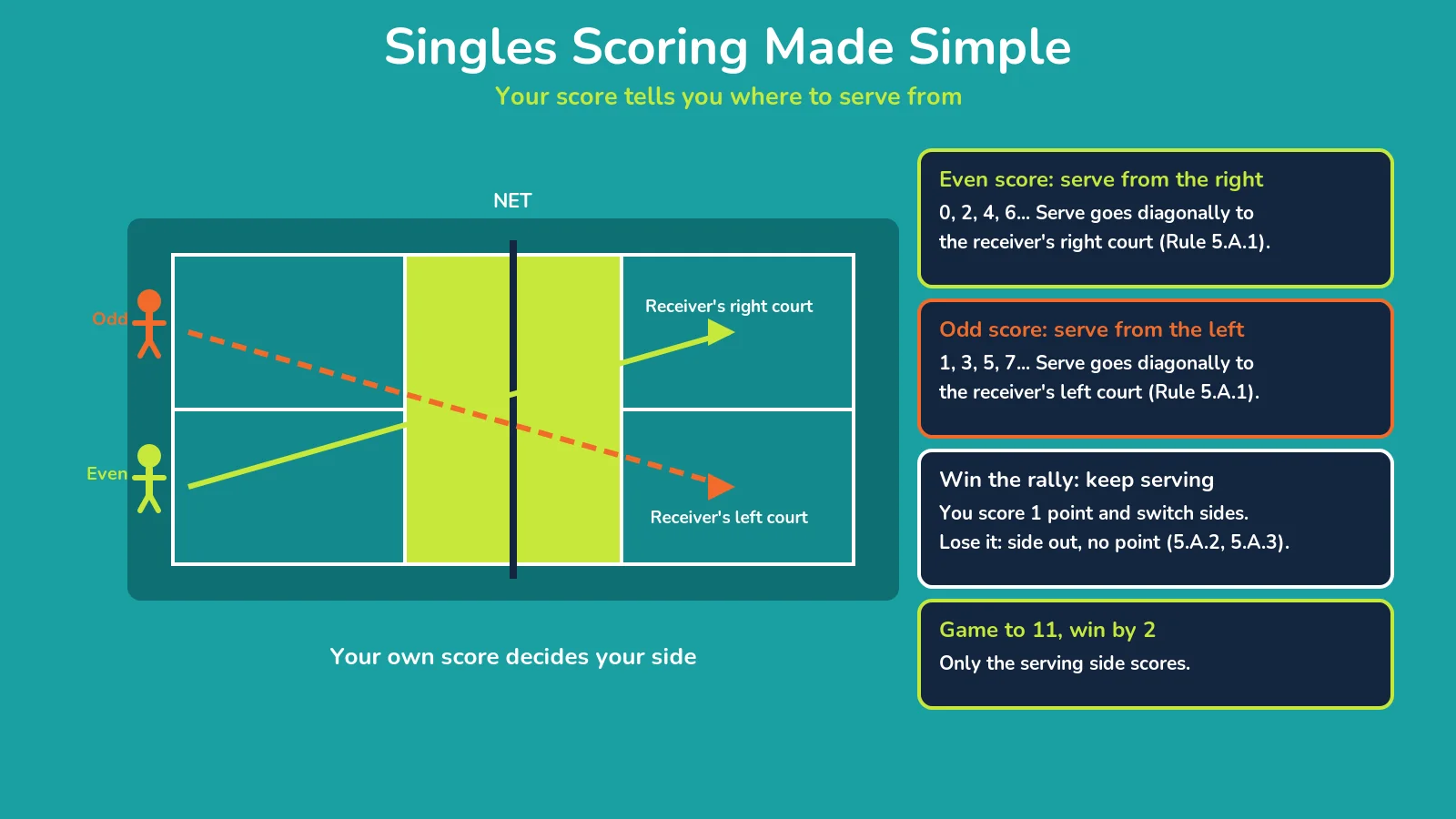
A simple way to remember it: when your own score is even (0, 2, 4 and so on), serve from the right side. When it’s odd (1, 3, 5), serve from the left side (Rule 5.A.1).
It’s easy to forget in the middle of a game and serve from the wrong side, so here is a small infographic on singles scoring that you can save on your phone.
What should be your serving strategy
The serve in singles can set up the whole rally. Here are the basics, just in case:
- For a volley serve, the paddle must move in an upward arc and hit the ball no higher than your waist, and the top of the paddle head must not be above your wrist at contact (Rules 7.C.1 to 7.C.3). A drop serve, where you let the ball bounce first, is also allowed (Rule 7.D).
- The serve must go diagonally, clear the kitchen and land in the correct service court (Rule 7.E).
- The serve and the return must each bounce before anyone volleys. This two bounce rule in pickleball (Rule 10.A) applies in singles too, so after serving, stay back and let the return bounce before you hit it.
Aim to place the serve deep to push the opponent back. Serving short will cause the opponent to smack the ball back at your feet where you can potentially lose a point.
If you are an intermediate player, you can mix up corner serves and body serves.
How to Position Correctly in Pickleball Singles?
If you position yourself in the wrong place, the ball will be aimed at the gap you left wide open.
Here are thumb rules:
- After every shot recover position to center court.
- Anticipate the opponent’s next move based on their position
- If the opponent is standing at baseline, they are likely to hit deep drives.
- If the opponent is at the kitchen line, they might be preparing for dinks.
The center position is your home base. You can easily step away and return the shots and reposition yourself at the center.
What strategy works best in Singles?
For Beginners
For beginners it’s always beneficial to keep everything simple in order to improve the game.
The basic shots like deep serves, deep returns, dinks etc. work best.
If you are planning too many things inside your head, it will confuse you as your body and brain won’t cooperate with each other.
Once your brain is free from technical things and focused on basics, you can work on improving these simple shots.
As you train yourself to position at center and develop these basic skills, improvise shots.
Intermediate players can:
- Use drop shots to pull power players forward.
- Serve wide and then attack in open space.
- Find out which side is weaker for your opponent and aim there to draw a weaker return.
Fitness for Singles Pickleball
In singles you cover the whole court alone, so some basic fitness work helps. (No court nearby? Here is a guide on playing pickleball on grass.)
Some simple workout drills:
- Sprint 10 to 20 meters. Repeat 3-4 times with 3 minutes of rest time in between.
- Work on footwork. For 5-10 minutes move as if chasing invisible shots.
- Incorporate core exercises such as planks, twists to keep balance while lunging.
For getting your body ready before you play, see the pickleball warm-up guide.
Common Mistakes New Singles Players Make
- Trying to smash every ball can backfire. That drains your energy faster and gives your opponent a chance to outlast you.
- The follow through motion: After hitting the ball, if you keep on looking at the ball instead of regaining the center position, you will definitely be in trouble.
- Lack of strategy: If there is no strategy you will be hitting the useless shots and running behind the ball like chicken.
Practice drills for improving skills
You need real games against an opponent to get better at singles, but you can still practise a lot on your own and work on your regular mistakes.
Wall drills: Hit the ball against a wall to build a steady, consistent rally, including soft dinks.
Serve drills: Stand behind the baseline on one side and hit serves into the diagonally opposite service court. Hit 20 to 30 serves, then switch sides and repeat. Note how many land in. The goal here is to avoid a side out due to a missed serve.
Cone Drill: Place 10 cones on the other side of the net, 5 in each half. Stand in the center and aim at each cone one by one.
Then move to the left side and repeat the drill, and then to the right side. This drill is helpful in improving the accuracy of shots.
FAQs
Q: Do you need to be very fit to play singles?
No. But you do need stamina for running side to side. The fitness drills above help.
Q: Is singles harder than doubles?
Physically, yes, because you cover the whole court. The rules are simpler, though: there is no second server, and the score has two numbers instead of three (Rule 6.B).
Q: Can beginners start with singles?
Yes. You’ll run more, and every shot is yours to play, so you get a lot of practice.
Q: Do you switch sides when serving in singles?
Yes. Each time you win a point on your serve, you move to the other side. As the server, your side always matches your own score: right when it is zero or even, left when it is odd (Rules 5.A.1 and 5.A.2). The receiver lines up by the server’s score too (Rule 5.A).
Q: Do the kitchen and two bounce rules apply in singles?
Yes, both work the same way as in doubles. You can’t volley while touching the non-volley zone, also called the kitchen (Rule 11.A.1), and the serve and the return must each bounce (Rule 10.A).
Conclusion
Singles pickleball surely needs more stamina, energy and it is exhausting. If you are switching from doubles to singles, it will expose every weakness that you were not aware of.
That’s the good part of singles. You start working on these weaknesses and soon you will find yourself improving with your game as well as overall fitness level.
Start by playing at least one singles game a week. Once you get good hold of it, you will keep coming back. Because the moment you win that long rally, you’ll know why singles pickleball is worth it.