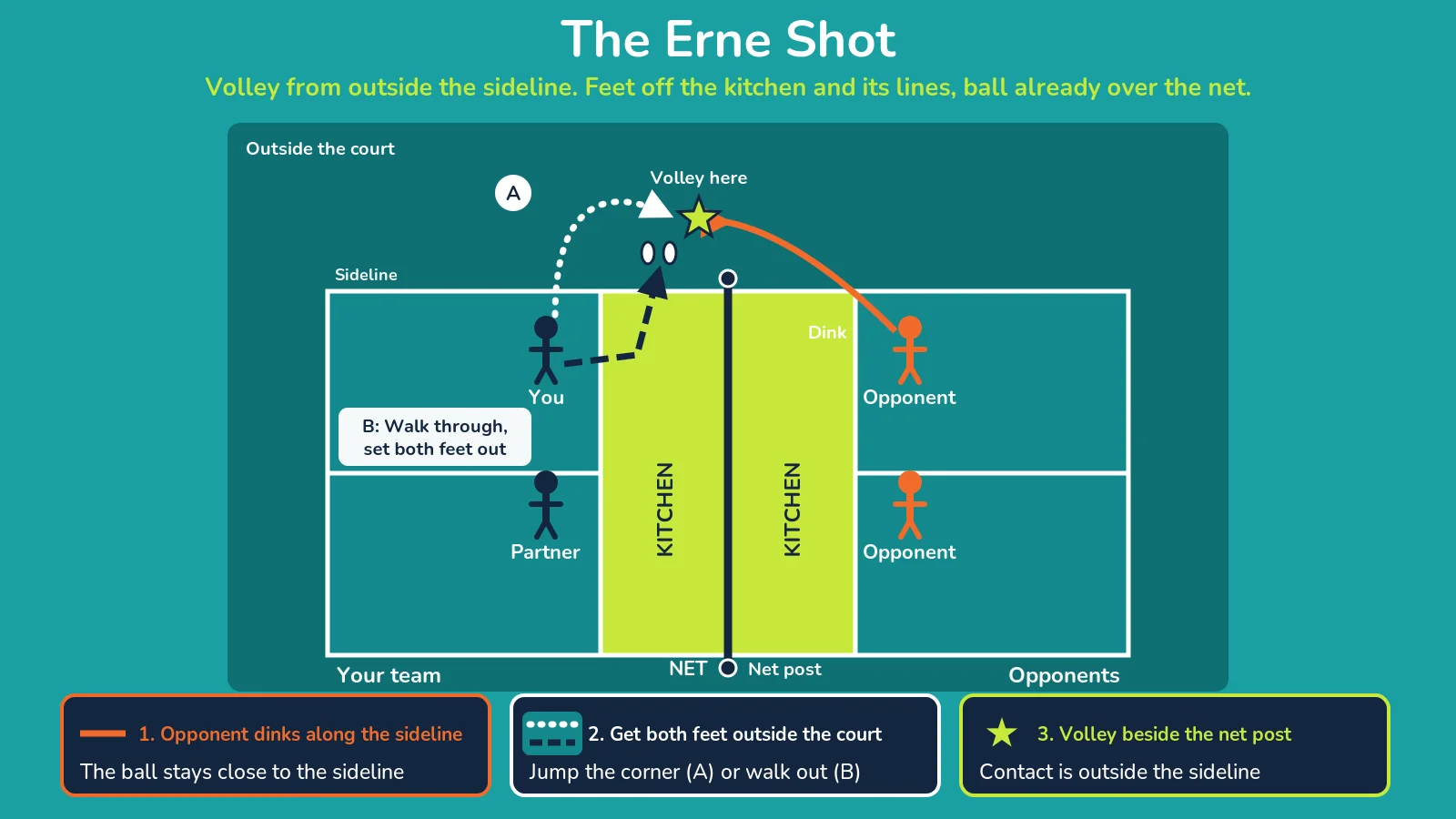
An Erne is a volley hit from beside the kitchen, usually from outside the sideline next to the net post. You get there by jumping over the corner of the kitchen or by moving around it, and you hit the ball before it bounces. It is legal as long as you don’t touch the kitchen or its lines while you volley.
In this article
Below I go through the rules from the 2026 rulebook, how the shot is set up, and how to defend when someone tries it on you.
What is Erne Shot?
First thing first: “what is Erne?”
The Erne shot is a quick volley which is hit from just over the corner of the kitchen and placed into your opponent’s court.
You don’t have to jump to hit one. A player can also walk around the corner of the kitchen, plant both feet outside the sideline and volley from there. The jump is just the faster way to reach that spot.

Erne Shot is named after early Pickleball player Erne Perry. He popularised this shot.
Key characteristics of Erne shots
- Erne shot is hit from outside the NVZ, after leaping over the corner of the kitchen or walking around it
- Player must clear the Kitchen line before and after the leap, or set both feet outside the kitchen before hitting
- The ball is volleyed before it bounces
Why is Erne needed?
You can’t volley from NVZ area. With Erne, you can hit the ball from above the NVZ area without actually stepping inside.
You still hit a legal shot and probably score a point if executed properly.
Don’t mix it up with the ATP shot. Both happen near the net post, but in an ATP the ball travels around the outside of the post instead of over the net (Rule 13.C).
It is easy and effective shot if you want to experiment more than dink or drop shot, if you can execute it at the right timing. So how do you know the correct timing to hit Erne?
How to Execute the Effective Erne
There are four aspects for successful execution of Erne shot: Positioning, The Jump, The Volley and The Timing
Let’s look at them one by one.
1. Positioning
First thing is the right position for executing Erne shot. Here’s how you position yourself
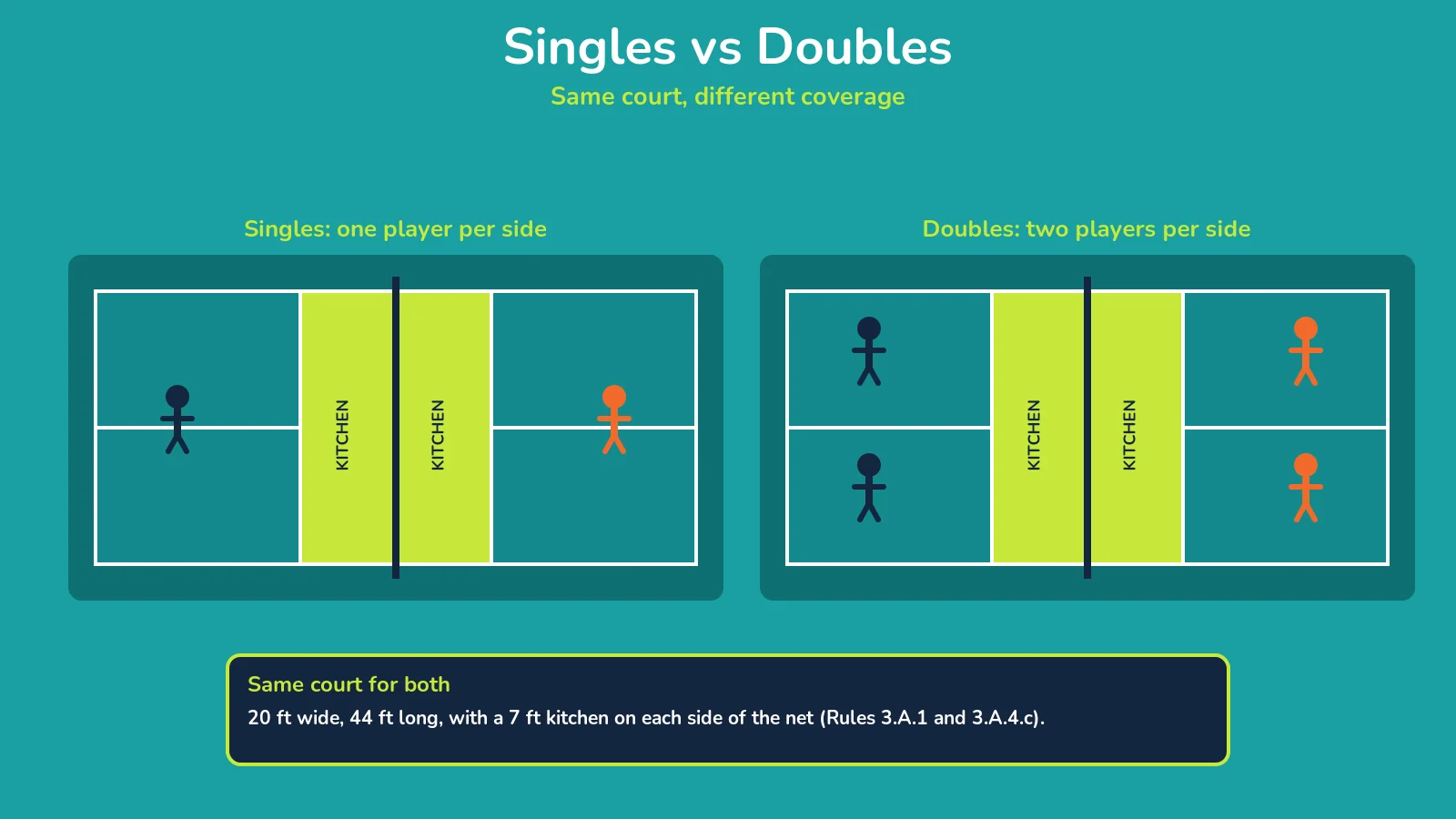
i. Stand at the middle part of your side if playing doubles and position near middle dividing line in case of singles
ii. Move sideways and laterally towards the sideline, don’t step inside the NVZ.
iii. Anticipate the opponent’s shot(I’ll explain this one later in this article)
2. The Jump
i. Make sure you jump forward and sideways. While jumping and landing, make sure no part of body is in contact with NVZ.
ii. Knees should be bent before the jump and ensure you land with knees bent only. It will provide necessary suspension to your legs without hurting you.
3. The Volley
i. If you jump, try to make contact while you are still in the air, i.e., after jumping and before landing. If you walked around the kitchen, both feet must be outside it before you hit.
ii. Target at the opponent’s feet, backhand and or open areas.
iii. Get back into neutral position as soon as shot execution is completed.
4. The Timing
i. Look for a dink that is travelling close to your sideline. That ball is the one you can reach from outside the court.
ii. Don’t be too quick, wait until the opponent hits the ball and immediately get into action. If you move early, they can see it and hit the ball somewhere else.
How To Use Erne Shot For Best Outcome
The Erne can be executed ideally during cross-court dinks. You can intercept high, slow dinks that are arcing toward the sideline.
Attacking shallow or high returns lacking pace or depth will give you best results.
During doubles, coordinate with your partner to force a predictable shot, such as a lob or angled dink. Of course you need to practice it together first.
Pro Tip: Use a wrist snap while hitting the ball this will add spin and make it even more challenging for your opponent to return the shot.
Practice Drills Erne: For All Skill Levels
Level 1 Drills: Beginners
i. Volley high balls from the sideline without jumping to understand positioning and timing. Stand just outside the NVZ sideline. Have a partner feed high, slow balls.
ii. Volley 10 consecutive balls without jumping, focusing on paddle angle and foot placement.
iii. Use light weight paddles (weight under 8.0 oz) for quicker reactions.
iv. Practice lateral shuffles along the sideline to develop agility. Use cones to simulate NVZ boundaries.
Level 2 Drills: Intermediate Players
i. Have a partner feed high, attackable balls to practice the jump and volley. Focus on landing outside the NVZ.
ii. Incorporate Fake Erne that let you reset for a dink or drive by disrupting opponent’s.
iii. After the shot, be quick to reposition yourself to the center. If you can’t do this quickly, Erne won’t be effective.
Level 3 Drills: Advanced Players
i. Add variations to Erne volleys. You can experiment it with deep drives, incorporating spin shots etc. to confuse opponents.
ii. In doubles, start hitting ball aggressively to create an opportunity to hit Erne.
iii. Attempt Erne early during the match to establish dominance. This gives you a psychological advantage over your opponent.
Common Mistakes to avoid
i. The Erne demands athleticism, Due to its nature there is an increased risk of ankle or knee injuries. So it is advisable that players should be prepared with right warm-ups before the game to reduce risk of injury.
ii. After the shot, be quick to return to a neutral position to counter returns.
Erne Rules in the 2026 Rulebook
Section 11 of the 2026 USA Pickleball Official Rulebook covers the non-volley zone. These are the rules that decide whether an Erne is legal:
Rule 11.A. Allowable Contact. “All volleys must be initiated outside of the non-volley zone. A player, or anything in contact with the player, may contact the non-volley zone at any time except during the act of volleying a ball.”
Rule 11.A.1. “When a volleying player or anything that has contact with the volleying player (including the player’s partner) contacts the non-volley zone, it is a fault against the player.”
Rule 11.A.2. “When a volleying player’s momentum causes the player to contact anything (including the player’s partner) that is in contact with the non-volley zone, even after the ball becomes dead, it is a fault against the volleying player.”
Rule 11.A.3. “After contacting the non-volley zone, when a player volleys a ball before both feet contact the playing surface completely outside the non-volley zone, it is a fault against the player.”
Rule 3.A.4.c. “The non-volley zone lines run parallel to the net, 7 feet (2.13 m) from the net on each end between the two sidelines. All lines that bound the non-volley zone are part of the zone.”
Rule 13.F. “A ball must entirely cross to a player’s end of the net before the player hits the ball.”
So the area outside the sideline is not part of the kitchen, and you can volley from there. Jumping is allowed too, as long as you take off from outside the kitchen and your landing doesn’t touch it. If your foot lands in the kitchen on the way, both feet have to be back outside before you hit. And you have to wait until the ball is on your side of the net.
How to Defend Against an Erne
An Erne only works when your dink gives the other player a ball close to their sideline. So the main defence is placement. If one opponent keeps drifting toward the sideline, stop sending dinks there and play them toward the middle.
Keep the dink low too. A ball that stays below the top of the net is hard to hit down, even from a good position.
If the player moves before you hit, they have left a gap behind them. A dink back down the line they just left, or a ball into the middle between them and their partner, is usually a better choice than hitting where they are waiting.
Conclusion
The Erne is an advanced shot. If you are new to pickleball, get comfortable with the dink and the kitchen rules first, then add the Erne. Have you faced or played Erne during a crucial game? Share your experience with us in the comments