I hadn’t even set my bag down when I heard the argument brewing.
“That’s your point! The ball bounced twice!”
“No way, I got to it in time!”
“Come on, the two-bounce rule is clear – you have to let it bounce before you hit it!”
“I did let it bounce! It was just…a fast bounce.”
A small crowd of Picklers gathered around the Court Three, murmuring, each person convinced they knew the rule better than the next.
It was a familiar sight – the picklers locked in a debate which sometimes would turn out heated over a rule that, despite its simplicity, still managed to create confusion.
As I tightened my shoelaces, I smiled.
Pickleball, for all its fun, has one universal certainty: sooner or later, everyone finds themselves arguing about the rules. And today, it seemed, was one of those days.
Did you figure out which rule they were talking about?
Yes! It’s two bounce rule (earlier known as double bounce rule more on this later)
If you are also one of those who are confused about the rule, let’s break it down once and for all.
What is the two-bounce rule?
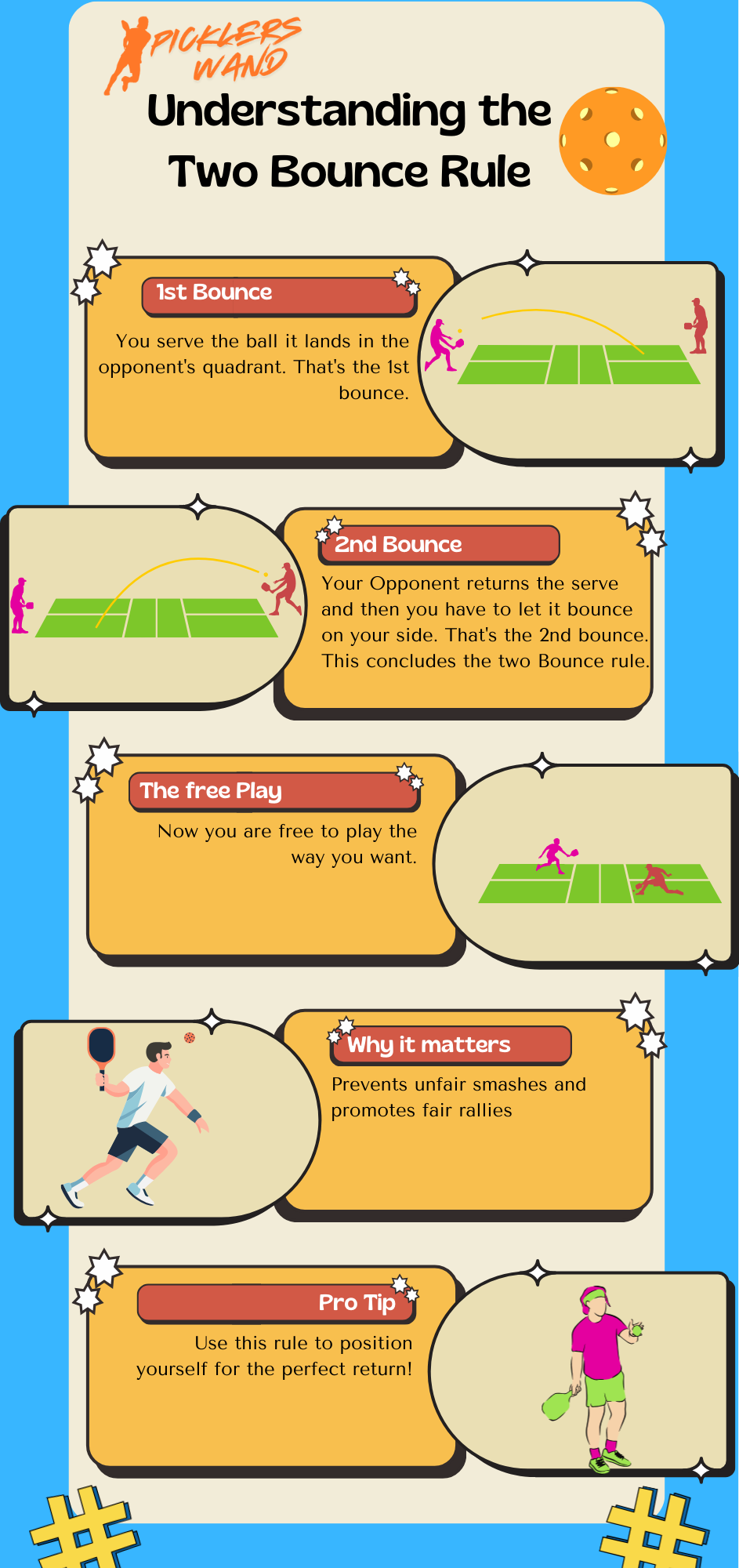
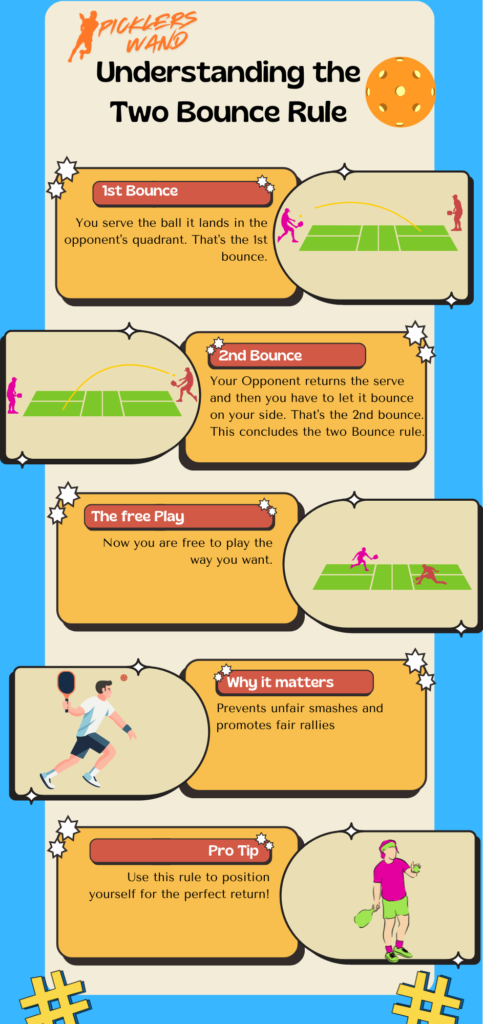
When the ball is served, the other team has to let it bounce before they can hit it back. Then, the serving team also has to let it bounce once before returning the shot.
After both teams have let the ball bounce once, players can hit it however they want—either letting it bounce or hitting it in the air.
Case I:
Imagine you’re playing your first game of pickleball, and the serve comes flying your way. You rush in and smack it back without letting it bounce, point lost. Or maybe you return it correctly, but your opponents volley it back right away again, an illegal play. Understanding this simple rule can save a lot of confusion and lost points.
Case II:
You’re playing a doubles match and it’s the Game point. Standing at the baseline you hit the serve shot. Your opponent ready to receive the serve, lets the ball bounce and return it clean. But you get eager as adrenaline takes over you and instead of letting the ball bounce on your side, you quickly step forward and volley the ball over the net.
You just lost the point and the game.
Since you didn’t wait for the ball to bounce before hitting it, the point goes to your opponent.
Why was the double bounce rule introduced?
The serving team could dominate the game with quick volleys by rushing toward the net, leaving no time for the receiving time to react. This would create an unfair advantage and make the game heavily one-sided.
By forcing both teams to hit at least one bounce before free play, it slows down the pace just enough to promote longer, more strategic rallies.
Another good thing which I feel is good about the Two-bounce rule is that it keeps the game balanced, preventing overly aggressive play that would make it difficult for beginners, older players.
Rather than just being a smash-and-volley contest, the two-bounce rule adds strategic essence to the game. Players must decide where to place their shots, anticipate their opponents’ next move, and position themselves wisely instead of simply rushing the net for quick wins.
Take out the two-bounce rule and you take out the strategic gameplay.
How to use the Two-bounce Rule for your advantage during the game?
Understanding the rule is one thing, but using it to improve your game is where the real fun begins. Here are some ways to turn the two-bounce rule into a tactical advantage for you:
1. Master the Deep Serve
As the receiving team must let the serve bounce before returning it, if you hit a deep serve, it will push them farther back, making their return shot more difficult.
This gives you more time to prepare for your next move.
2. Control the Return Shot
Similarly, if you are playing at the receiving end, your goal should be to return the ball deep into your opponent’s court. This forces them to stay back and makes it harder for them to move quickly to the net, where they can dominate with volleys.
3. Use the Third Shot Drop Effectively
The third shot drop is a key strategy in pickleball, and the two-bounce rule sets it up perfectly.
It is a soft, controlled shot hit by the serving team on their third shot (after the serve and return), designed to land in the opponent’s non-volley zone (also called the kitchen).
Since both teams must stay back for the first two shots, a well-placed drop shot can bring the serving team up to the net in a controlled, strategic way rather than rushing in recklessly.
4. Avoid Rushing in Too Early
Many players make the mistake of running toward the net right after serving, only to be caught off guard when they realize they still have to let the return shot bounce. Instead, stay patient and prepare to hit a solid third shot after the bounce.
Is Two-bounce Rule same as Two-bounce fault
Many new players confuse two bounce rule with a two-bounce fault. But these two are totally different, let’s break it down for you.
A two-bounce fault happens anytime the ball bounces twice on one side before being hit. This results in a fault, and the opposing team wins the point.
Example of a Two-Bounce Fault
The ball is hit toward you, but you don’t react in time, and it bounces twice before you can return it.
You misjudge a shot, thinking it will go out, but it lands in and bounces twice before you attempt to hit it.
In pickleball, letting the ball bounce twice before hitting it is always a fault, except in wheelchair pickleball, where two bounces are allowed before a return.
Remember this..
Two-bounce rule = A must-follow rule at the start of every rally.
Two-bounce fault = A mistake that happens when a player lets the ball bounce twice before hitting it.
Have you ever been in a heated debate over the two-bounce rule? Have you seen or made a two-bounce fault in a crucial moment? Share your experiences, thoughts, or even your favorite pickleball tips in the comments below!