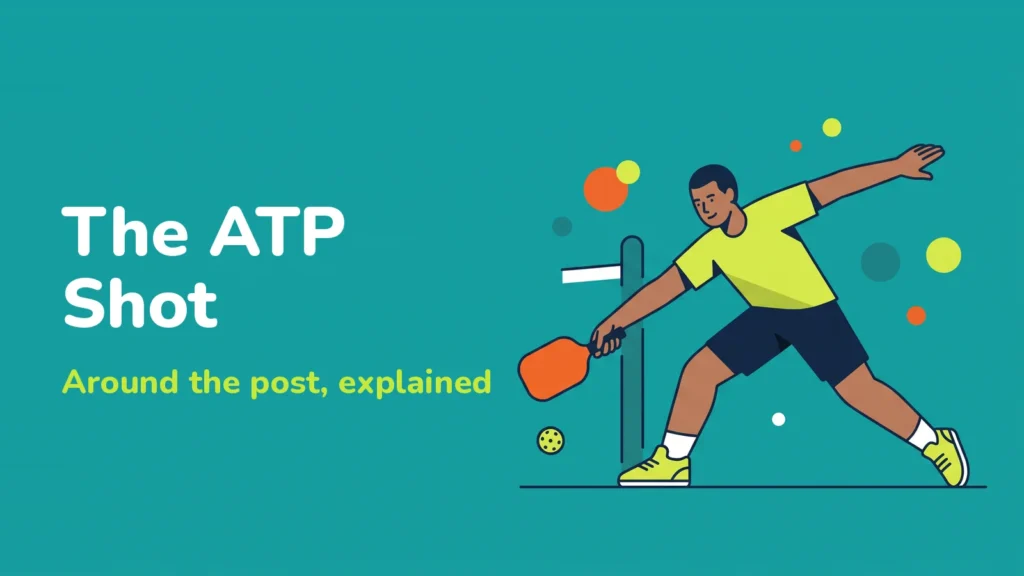
An ATP (Around The Post) shot is a return hit around the outside of the net post, rather than over the net, that lands in the opponent’s court. It is legal under Rule 13.C of the 2026 USA Pickleball rulebook, while Rule 13.D says a ball must not be hit between the net and the net post.
In this article
Have you ever thought of experimenting with more than dink, drop, Erne or spin shots in pickleball? If you follow professionals like Ben Johns, you must have noticed a wide range of shots being played during tournaments, like this ATP at a PPA tournament that clinched a game point.
So what exactly is an ATP shot?
The ATP is a shot where the player hits the ball around the net post instead of over the net. The ball travels outside the post and lands inside the opponent’s court. It sounds like a trick shot, but it is simply what happens when an opponent’s angle pulls the ball so wide that the shortest way back is around the post.
The official 2026 USA Pickleball Rulebook covers the ATP and the rules around it as below.
Rule 13.C. Ball Around Net Post. A ball may be returned around the outside of the net post.
Rule 13.D. Ball Between Net and Net Post. A ball must not be hit between the net and the net post.

When is it a valid ATP shot?
Three things have to be true. The ball goes around the outside of the post. It does not touch the post or anything attached to it. And it lands inside the opponent’s court.
The height of the shot does not matter. Rule 13.C does not ask the ball to go over the net, so it can travel lower than the top of the net and still be good. That is what makes the shot hard to defend, because a low ball coming from outside the court stays low after it bounces.
The post itself is the part to watch. The rulebook lists net posts, including their wheels, arms and legs, as permanent objects. Under Rule 10.C.4, a ball that contacts a permanent object before bouncing on the court is a fault against the player who hit it. So a ball that clips the post on its way around is not a lucky winner. The same rules cover any shot that touches the net system, as explained in what happens when the ball hits the net. It is your fault.
What about your feet and body?
An ATP usually pulls you well outside the sideline, sometimes level with the net. The rulebook has three rules that matter here.
Rule 13.I.1 lets a player cross the plane of the net immediately after hitting the ball, as part of the same stroke and its follow through. Crossing it before you hit the ball, or without hitting it, is a fault under 13.I.1.a and 13.I.1.b.
Rule 13.H says you, and anything you wear or carry, must not touch your opponent or the opponent’s end of the court while the ball is live. Running past the post after the shot is fine. Stepping onto their court is not.
Rule 13.G says you must not touch the net or the net support system while the ball is live. When you are stretching around the post, that includes brushing it with your paddle or your hip.
How to execute an ATP
To hit an ATP, you need to read the incoming ball’s path early. The chance only exists when your opponent’s shot is wide enough to pull you outside the sideline before you make contact. Pickleball.com’s coaching article on the ATP puts it plainly: if the ball stays inside the sideline, you cannot legally go around the post.
You can try to create this chance by drawing your opponent into sharp cross court dinks, which takes a lot of skill, or you can simply play the rally and wait for it. In either case, once you see the ball going wide, start moving.
Coaching sources agree on a few basics. Move your feet early and get outside the ball, so you have room to swing past the post instead of reaching for it. Stay low with your knees bent. Use a short, compact swing with the paddle face slightly open, more like a firm push than a full drive. Hit the ball out in front, and do not try to add power, because placement wins this shot and extra pace sends the ball long or wide.
The Dink Pickleball’s tips add two details worth trying. Let the ball come as late as you can and contact it with the arm close to straight, and keep most of your weight on your outside leg. For a right hander hitting a forehand ATP, that is the right foot.
Aim cross court into open space, or down the line if your opponent has moved toward the middle. Then recover quickly, because a good opponent can still get the ball back while you are off the court.
ATP drills for beginners
Stand just outside the sideline near the kitchen line and ask your partner to feed wide dinks toward you. Try hitting ATP shots from that position, aiming at a small target area on the other side. Stay in a ready position between shots.
Before you hit at all, a useful first step from Pickleball.com is to have your partner hit sharp angles while you only call “ATP” or “No” and move your feet. This trains you to recognise the chance early, which is where most missed ATPs go wrong.
ATP drills for more advanced players
Start with cross court dinks with your partner. Ask them to begin with simple dinks and then send you wider shots. Go for the ATP whenever the ball is wide enough, and play a normal dink or reset when it is not. The decision is part of the drill.
Advanced players can add lateral footwork drills to this, and can try adding slice or topspin to the ATP once the flat version is reliable. After every attempt, have your partner put the next ball back in play, so you practise recovering instead of watching the shot.
When is an ATP useful?
Hitting an effective ATP is mostly about recognising the right incoming shot. If a sharp cross court dink is forcing you outside the sideline, that is the clearest opportunity. When the incoming ball is too low to return high over the net, an ATP lets you send it back low and around the post instead.
In doubles, call it early. Coaching sources such as LetsPickleball suggest saying “ATP” so your partner knows to cover the middle while you are off the court.
The ATP is worth learning because the situation that creates it, a wide angle near the net, comes up often once rallies move to the kitchen line. Most of the time the right choice will still be a normal dink, but knowing the rule means you will not miss a free chance when the ball is wide enough.
Sources: USA Pickleball Official Rulebook 2026, Section 2 definition of Permanent Object, Rules 10.C.4, 13.C, 13.D, 13.G, 13.H, 13.I.1 (https://usapickleball.org/docs/rules/USAP-Official-Rulebook.pdf); Pickleball.com, “Mastering the ATP in pickleball: Timing, footwork, and smart execution” (https://pickleball.com/learn/mastering-the-atp-in-pickleball-timing-footwork-and-smart-execution); The Dink Pickleball, “Three Pro Tips for a Killer ATP” (https://www.thedinkpickleball.com/three-pro-tips-for-a-killer-atp/); LetsPickleball ATP guide (https://letspickleball.com/around-the-post-pickleball-atp-guide/).