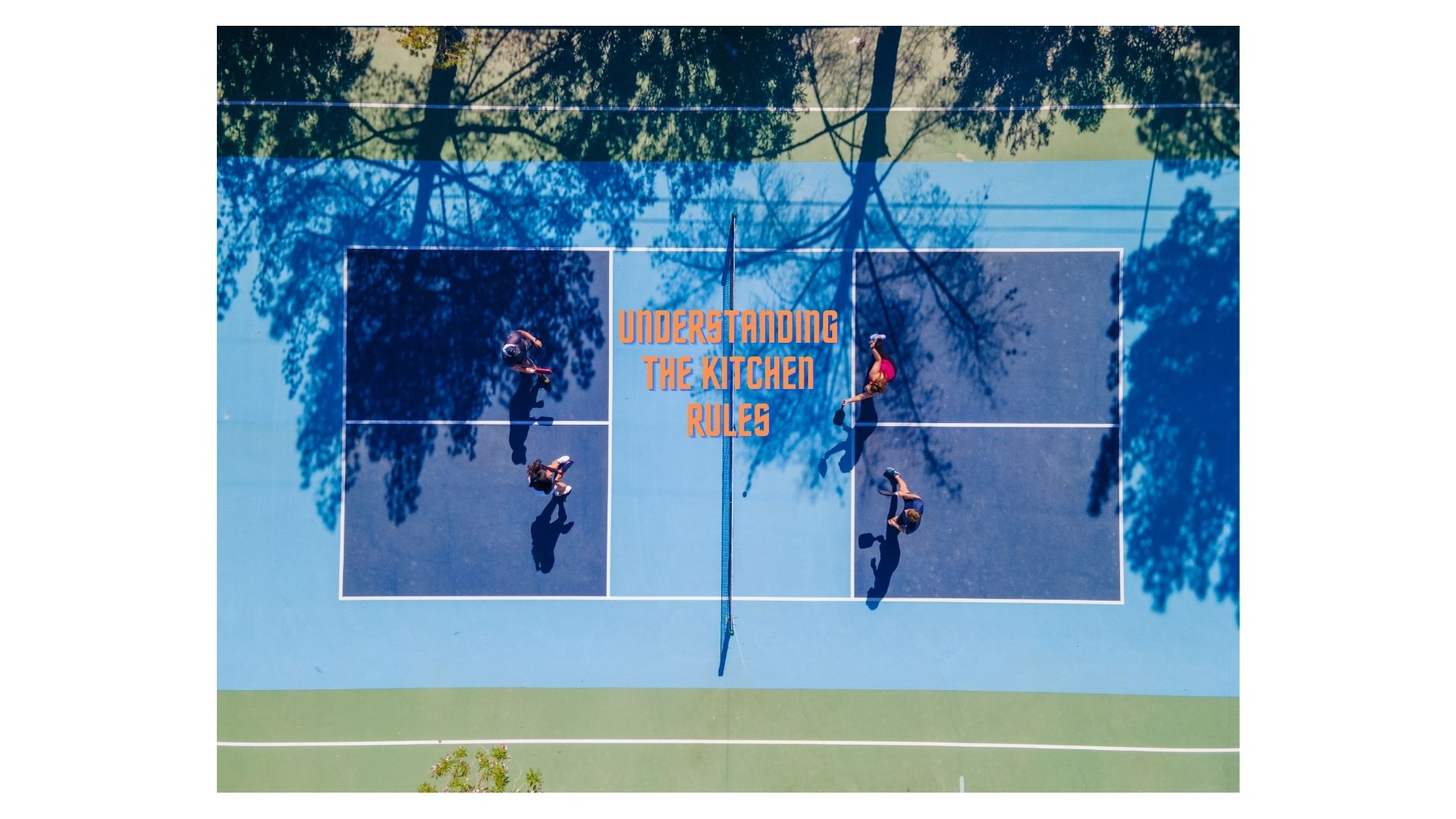
Hello picklers! Today we’ll dive into the fundamentals of the Kitchen area. And guess what this article is not about cooking (I know my sense of humour sucks)
Pickleball’s “Kitchen,” or Non-Volley Zone, is where real strategies are cooked up. Mastering the rules of this area is crucial for refining your game.
So let’s learn the “recipes” that can help you craft winning strategies in the NVZ.
First let’s understand “What is kitchen or NVZ in pickleball”
The pickleball court looks like this when viewed from top.
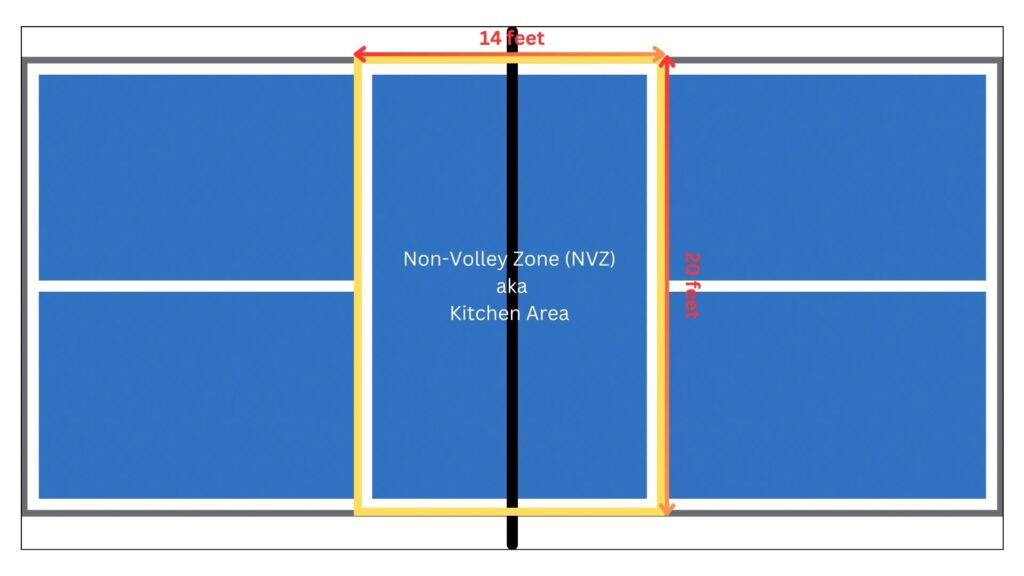
The area highlighted with the yellow rectangle is called Non-volley zone (NVZ) and widely referred to as “Kitchen Area” in pickleball lingo.
The first and most basic rule of the kitchen area is you cannot volley (play the ball in air) in this area. Simple to understand “Non” – “Volley” – “Zone”
Dimensions
The Non-volley zone area is 14 feet x 20 feet in the middle of the court. This area is divided in the middle with a net, making a 20 feet x 7 feet kitchen area available on each side.
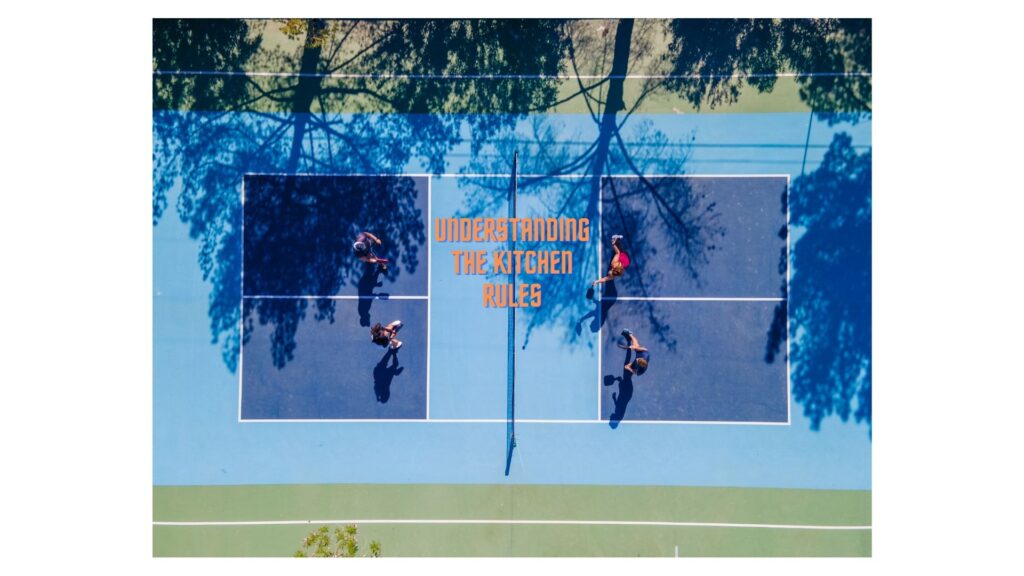
Let me tell you this division is not just for the show. The kitchen line is where most of the quick, intense actions happen – the shots such as dink, ernie, third shot etc. that can potentially impact the outcome of your game.
Why are kitchen rules important?
Here’s my story when I started. Back in my early playing days, I used to stay away from the Kitchen area throughout the game.
I wasn’t very comfortable playing around this area as my eyes would be constantly busy tracking the kitchen line in order to avoid stepping on it and losing points.
Additionally, I was afraid to run backwards to return the ball that the opponent had smacked high into the service area.
All this trouble I was taking out of ignorance about the NVZ area.
However this approach was only restraining me as,
- I was unable to return dinks
- I wasn’t part of volleys most of the times
- And my game was not improving at all
Finally I realized that understanding Kitchen (NVZ) rules is the only way to move forward.
Understanding the kitchen area dynamics:
Section 9 of “USA Pickleball Official Rulebook (2026)” outlines all the rules applicable in this area. There are a total of 8 rules covered in 2 pages. You can read detailed rules of the game here. https://usapickleball.org/docs/2025-USA-Pickleball-Rulebook.pdf
However, beginners often overlook them, assuming that it is just No Volley Zone. Sadly, they waste a lot of time learning these things the hard way.
It is similar to a degree exam, where you prepare for one thing but the actual exam throws unexpected, tricky questions your way.
Rule 9.B.1. Defines what is “The act of volleying”: It begins when the ball is struck out of the air before bouncing (volleyed) and ends when the player’s movement from the follow-through action (momentum) stops.
The most common misconception among picklers is that during volley, they can step into NVZ after hitting the ball. This is only partially true. As per the rule if the momentum of Volley shot carries you into the kitchen area, it is considered as fault.
Interestingly, It will still be considered a fault when the ball is out, faulted or missed by the opponent, and your momentum of shot carries you into NVZ.
Rule 9.H. clears another popular misconception: “There is no violation if a player returns the ball while their partner is standing in the non-volley zone as long as the partners, including anything the partners are wearing or carrying, do not contact each other during the act of volleying.”
Here are some common Misconceptions about kitchen area
- You can’t volley from mid air in the kitchen area –
Even though the kitchen area is NVZ, it is only the surface area that counts as NVZ. It means that you can hit the ball mid air over the Kitchen area during volley as long as any part of your body is not touching the kitchen area.
- You can’t step into the kitchen area after returning the ball that has bounced – A player can enter NVZ anytime before or after returning the ball that has bounced. In fact the player can stand inside the kitchen to return any ball that bounces.
- The serve can land in the kitchen area: Your serve must always land in the diagonally opposite rectangular area, it will be considered as fault even if it drops in the kitchen area.
Key takeaways from this article
- Positioning
- Stand at the edge of the Kitchen line to execute concise shots.
- This positioning helps you to anticipate shot trajectories and adapt quickly for the shots converting from dinks to volley or vice versa
- Balanced momentum
- Focus on maintaining balance and ending momentum at the edge of NVZ
- This approach keeps you efficient while avoiding faults related to stepping into the kitchen at the wrong time.
Did you find this article helpful? Also let me know what kind of misconceptions you carried about the kitchen area. I would love to hear from you in the comments below.