Pickleball without a warm-up is like flooring your car the moment you turn the ignition. It will work once or twice but sooner or later your knee, calf or shoulder will give it back.
Here’s the problem, Pickleball doesn’t stress your body forward like jogging or cycling. It strains your body sideways.
The quick shuffles with sudden stops, lunges and quick movements at the kitchen line impact your joints and muscles. And if you are not warmed up before the game, it can soon convert to injury.
Most injuries occur early during the game. It can happen due to the first wide dink or fast exchange when you are not yet warmed up. The body reacts slowly when it’s early in the game. Joints are still stiff and reaction time is slow this eventually leads to injury.
In Pickleball, the ball is light but don’t mistake it as a low impact game. Your knee has to absorb sharp movement repetitively. And your knees are not alone, your calves, achilles handle, shoulders and elbows too are equally strained.
So jumping directly in action without warming up your movements won’t be balanced, controlled and you’ll be less confident on the court.
Importance of Pickleball-Specific Warm-Up
While warming-up for Pickleball, you should choose appropriate exercises. Jogging or stretching might warm up your body, but it doesn’t prepare your body for Pickleball game.
The Reaction time matters most during the game. At the kitchen line, you don’t have time to think as it’s the area where quick shots such as dinks are passed. Unless your body is warmed up your reaction time will be slow.
The warm-up should mimic the on court movements such as lateral shuffles, quick lunges, split steps etc.It should also include movement for your calves, knees, calves and hips. The upper body involves your shoulders, elbow and wrists for controlled shots, volleys, soft drives etc.
So it is very important that your warm-up should be specific to the game movements in Pickleball. If your warm-up doesn’t mirror how you’ll actually move on court, it’s incomplete, no matter how long it takes.
The Quick 5-Minute Pickleball Warm-Up
It’s not ideal but when time is tight, even a five minute short warm-up can make a difference.
As time is short, this warm-up is not going to be focused on flexibility. Your goal should be to wake up the muscles and joints as fast as possible before the game starts.
We’ll start from the lower parts then proceed to the top.
Ankles and calves come first. Perform a few ankle circles, calf raises and gentle bounces to wake up the muscles.
Perform hip openers and shallow lunges for lateral reach
Next go for sideways movements. For 30-60 seconds, perform lateral shuffles and split steps. These movements will reduce stiffness in leg muscles and you’ll feel lighter during the game. This is a must warm-up so make sure you don’t miss it before the game.
Finish with upper-body activation.
- Arms swings
- Shoulder rolls
- Wrist rotations
Slowly and effectively you’ll get your blood flowing through joints. And you are ready for the game in just 5 minutes. Your body will thank you.
The Complete Pickleball Warm-Up
Now let’s get serious. The 5 minute warm-up routine is not a recommended thing for every time. You must put extra effort by giving 10-15 minutes for warm-up sessions. This ensures your body is ready for every game.
This is the gold standard if you want to play well and keep playing long term.
A complete warm-up should follow the sequence:
- mobility,
- activation and,
- game-speed.
Keep that in mind and don’t mess with the order.
Starting with mobility, your joints need extensions for game. The three key areas to focus on are ankles, hips, and shoulders.
- Rotate ankles 10 times in clockwise & counterclockwise direction
- Rotate shoulders 10 times both clockwise and counterclockwise direction
- For Hips – Relax your posture and do easy 5 lunges each per leg. This helps loosen the stiffness.
Next comes activation. This is where your body is switched on.
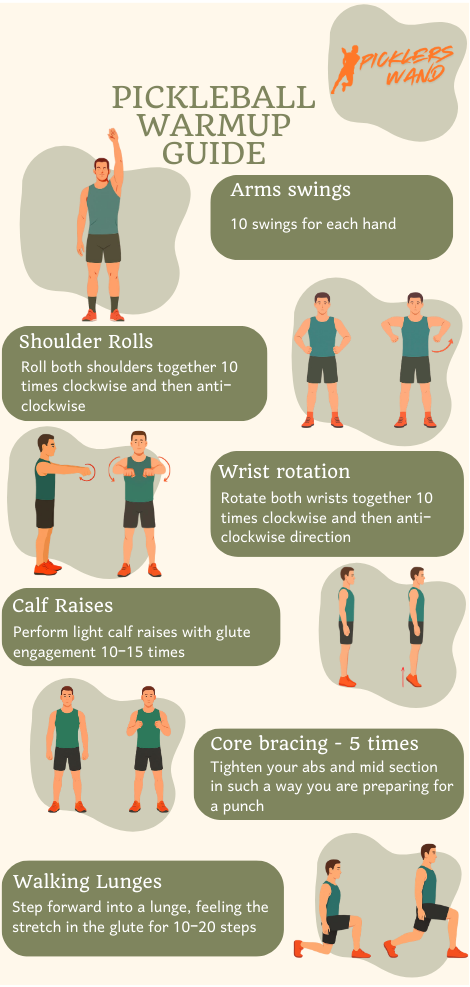
- Perform light calf raises with glute engagement 10-15 times.
- Core bracing 5 times – Tighten your abs and mid section in such a way you are preparing for a punch
- Walking Lunges 10-20 steps: Step forward into a lunge, feeling the stretch in the glute
Don’t push too hard, as you don’t want to be tired before the game. Perform these warm-up exercises in relaxed posture.
Download and save below infographic for ready to refer warm-up exercises
Next is the last part preparing for game-speed.
You can improvise here as per your skills. Use short lateral shuffles, split steps, and controlled shadow swings to sync your eyes, feet, and hands.
With this you get over the sloppy feeling in the game and your moves will be controlled and confident from the start.
On tournament days, or long play sessions, this warm-up routine is a must to avoid injuries and stay alert on court.
Common Warm-Up Mistakes
Choosing the wrong warm-up before the game will also hurt you just like skipping it.
Mistake 1: Stretching before the game.
Stretching feels productive, but it doesn’t prepare your body to react. It won’t help you for quick movements. It is better to do stretching after the game
Mistake 2: Jogging-only warm up
Straight line jogging won’t be helpful with sideways lunges.
Mistake 3: Treating 1st game as warm-up
Stay away from this trap. You’ll be inviting injuries for sure. When the game starts, all it will take is a wide dink and your body starts talking back to you.
Mistake 4: Overdoing warm-up.
Remember that a warm-up is not a workout. Don’t sweat yourself with just warm-up or you’ll be tired before the game.
A good warm-up gets you ready and alert and not stiff and exhausted before the game.
Is it necessary to Warm-Up Before Every Match During Tournaments or Back-to-Back Games
Many players feel that if you have warmed-up just before the first game, you don’t have to warm-up anymore. But that’s not how your body works.
Many players feel great during the first match and sluggish during the next matches. Especially during cold or windy conditions, calves, hips, and shoulders tend to be common problem areas.
Your body cools down much faster than you think. After a game, resting 30-45 minutes will cool your body down. In such a situation, if you are asked to play suddenly, that again can be bad for you.
This is where you incorporate micro warm-ups. You don’t need to do a full 10 minutes of warm-up routine, you can proceed with light movements such as ankle bounces, shuffles, arm swings, and short split steps for a few minutes.
This also gives you confidence as your body feels warm and ready before every match. Your success in a tournament isn’t just about skills, you have to micro manage all aspects to keep yourself ready and alert that can ultimately lead to your success in the tournament.
Conclusion
Warm-ups are an inseparable part of any physical activity be it Pickleball or workout. Skipping them can stall your progress for long periods. They often act as diagnostic tools. If you feel something is off during the first few minutes of workout, it’s always a good idea to skip the game.
Mild stiffness often improves and soon turns into sharp pain and discomfort if you choose to continue. Knowing when not to push yourself is key to keep yourself consistent and improve your game than getting injured and losing routine.
It’s not always the signal to skip a game, if it’s not a tournament and just a regular session, you can shorten the session timings. You will avoid aggressive lunges and lateral movements. It’s called smart adjustments to keep yourself consistent with practice.
Are you a warm-up person or do you often skip them? What are your experiences with and without warm-up during games?