A few months back, me and Sarah were playing doubles at a local tournament.
We were at the kitchen line and the rally sped up. One fine return from the opponent caused both of us to run toward the ball and as it happened our paddles collided.
I had bought Selkirk Vanguard Power Air Invikta couple of months back. It was a good Black Friday deal and I grabbed it for $180, a solid $50 discount.
The clack was so hard that it made me think “Did I just break my paddle?”
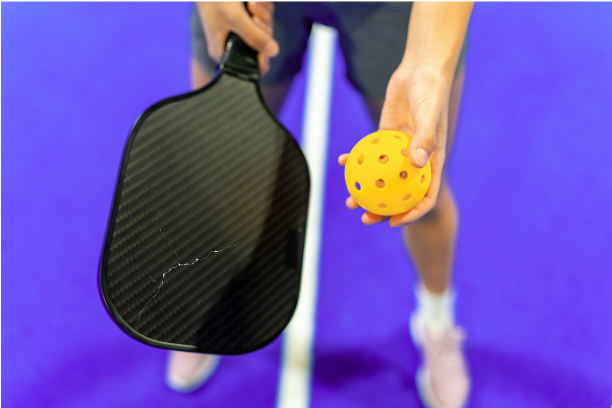
I froze and had a second look down. And there was a thin crack running along the edge of my paddle.
And here’s the thing, I had heard about paddle clashes earlier but never thought it would happen with me. After this incident I can comfortably say now – “Paddle clashes happen to pretty much everyone eventually.”
But what about the crack on the paddle? It actually looks more serious than it actually is.
Most picklers rush to buy a new paddle once they see a crack on the paddle. Honestly, in a lot of cases the damage is just cosmetic, and it doesn’t affect the performance of the paddle.
Most of the time you will get the same spin, same feel, same everything.
So before you rush and browse for a replacement, let’s see what you are actually dealing with.
A couple of simple things can tell you a lot.
Cosmetic Crack vs Real Damage (The Important Difference)
The first thing picklers do after paddle clash is to flip it over and stare at it. They try to deduce whether it’s still good or start browsing amazon by the end of the session.
Here’s the good news.. Not every crack is a death sentence for your paddle.
Most of the time the damage is cosmetic – meaning the small crack might only be breaking through the outer surface layer. The core of your paddle is completely fine. This also means that you can keep on using it without any impact on performance in the spin, control or power.
There is another type of damage you might come across is Edge guard damage. It can occur when the two paddles collide or your paddle goes too low while returning a shot that it brushes too hard against the ground. The edge guard’s job is to absorb the impact. A little crack or chip on the edge equals zero effect on the paddle.
So what type of damage is serious?
What you can really call concerning is core damage.
All Pickleball paddles are manufactured with a honeycomb-style core inside. That’s where all the performance, feel and responsiveness of the paddle resides.
The damaged internal structure or the one that starts to separate, directly impacts the performance of the paddle. You’ll know it when shots are lacking the pop, the sweet spot almost disappears and the spin goes inconsistent.
So instead of staring and discarding the paddle instantly because of a crack, you should look for the above clues. And for that you need to hit a few balls with it and then decide the fate of your paddle.
The 60-Seconds Paddle Test You Should Do After a Clash
Right after paddle clash instead of staring at the paddle and thinking how bad the crack is, here are few tests that will only take 60 seconds and help you determine the condition of your paddle.
- Bounce Test: Drop a pickleball onto the paddle face from short height. Repeat it 3 times and observe the bounce. Does it feel normal and consistent? That’s a green light and a sign that your paddle’s core is intact.
- Sound Test: Hit a few soft shots or gently tap on the paddle face. If the paddle is good you’ll hear a crisp and clean pop sound which you’re used to hearing. In case it sounds dull or goes mute, it could mean that the core of the paddle might be affected.
- Spin Test: So this one is for those who can actually play spin shots. Hit a couple of topspin or slice shots if the ball is still gripping and spinning like it was before then your paddle is fine.
- Flex check: The last one and the quickest one. Gently press near the cracked area with your thumb. If the paddle feels firm and solid it’s probably in good shape. If it feels soft at the place where it shouldn’t be, then that could be an indication that there’s some problem.
Here’s takeaway – Don’t just rely only on one test. Run all these tests repeatedly and see if everything is consistent as it was before. If it is, your paddle is most likely playable.
Can You Keep Playing Pickleball With a Cracked Paddle?
After spotting a crack and running above tests most of the picklers still need a straightforward answer for – “Can you still play with the paddle or you need a new one?”
The answer is “Yes” in most of the cases. If the crack is small and has only affected the surface or the edge guard, as it usually doesn’t affect the performance of the paddle. You can keep playing with the paddle, and there are many players who continue playing with cracked paddle without any issues.
When you feel that your paddle has suddenly lost the power on the drives, losing the spin, the sound when the ball touches the paddle is dull – that usually means it’s time to replace it.
Another thing to note here is cracks don’t stay of the same size. Regular use of a paddle can spread the crack slowly deep into the structure, worsening its performance. The change might be gradual until you notice it.
For rec games, a slight crack on the paddle is fine.
Should You Repair It or Replace It?
Honestly, most of the pickleball paddles aren’t built to be repaired. But that doesn’t mean you keep that crack open. For minor edge guard cracks you can use super glue, epoxy or tape to hold it together.
If the damage is purely cosmetic, then such a fix can stop crack from spreading and your paddle will last longer.
But if you’re participating in a competitive tournament, it’s worth knowing that the visibly damaged paddles can sometimes get flagged. There is a term for it – “delaminated”.
What Is a Delaminated Pickleball Paddle?
A delaminated paddle is where internal layers of Pickleball paddle have started separating from each other. As there are multiple layers of every paddle, sometimes the bond holding them together weakens or breaks down. So those layers start coming apart.
And this is different from a simple crack. Delamination is a structural failure. The paddle starts feeling soft or spongy. The ball might bounce off with more power than expected. Sometimes
So what actually causes it?
The hard impact or paddle clashes are common reasons. But it can also happen due to regular wear and tear or heat exposure.
You can’t fix the delaminated paddle, so you should start looking for a replacement immediately.
Will the Warranty Cover a Paddle Clash?
Eventually everyone comes across this question. Sadly in most cases, brands don’t cover the paddle clashes.
Most of the Pickleball paddle brands classify this kind of damage as player-caused. Which is actually right from their POV. The manufacturing defect is what they consider under warranty.
So if you are thinking about claiming warranty, it is likely going to get rejected, especially when there are obvious signs of impact on the paddle.
Warranties cover things like delamination without any impact involved, loose edge guards or defects that show up during normal play.
That said, some brands will offer goodwill replacements or at least a discount toward a new paddle, particularly if yours is fairly new like it was in my case. I simply reached them out and asked politely and they agreed to give me a fair discount on purchase of another paddle.
How to Prevent Paddle Clashes in Doubles
If your paddle is cracked due to a paddle clash, then there’s a chance that it won’t be your last. Especially if you’re regularly playing doubles. The majority of the players think that clashes are just freak accidents. But it is also true that these clashes often happen when the ball is landing in the middle.
So a simple rule to keep in mind is “Forehand takes the middle”. Since the forehand generates stronger and more controlled shots, it shouldn’t be hard to remember.
This one simple rule removes that split-second hesitation and makes a decision for you.
Another thing you can do is communication during the game. Calling “mine” or “yours” early helps to reduce confusion with your partner.
It has been observed that most of the paddle clashes happen right at the kitchen line. The reason: that’s where the game speeds up most and reaction time goes down. When the ball is coming fast and you have to decide in second, the chances of clashing paddle with your partners go up.
Define your area of control by keeping clear spacing between both of you. With a bit of experience you will naturally develop the awareness of the space around you and your partner without even thinking about it.
Conclusion: The Truth Most Paddle Brands Won’t Tell You
Most of us mistake the high price of paddle cost with longevity. Although that seems fair, that’s not how modern Pickleball paddles are built. Today’s paddles are built for performance first. And for that purpose, manufacturers use the materials and methods that aren’t meant to absorb hard impacts or paddle to paddle collisions.
Take carbon fiber for an example. The market is full of these types of paddles today because it generates great spin and is responsive which is what players love. But it is also highly prone to surface cracks due to paddle clashes. The performance and longevity of the paddle are inversely proportional.
A lot of newer paddles are designed thinner and more responsive for the game but these don’t absorb the sudden hard impact due to clash resulting in crack.
Here’s the thing – paddle clashes are genuinely common, especially in doubles. But the brands won’t mention a word about it anywhere in a product description or in their marketing. They all focus on performance, spin, power drive etc. and durability? Not so much.
It’s a trade-off, a high-performance paddle might feel incredible out on the court, but it’s not designed to handle repeated collisions.
Keep that in mind and a crack after a clash won’t feel like some defect or failure.